
← All marine life
Queen Triggerfish
Species IUCN · Near Threatened (NT)

Queen Triggerfish

Balistes vetula, Linnaeus, 1758

marine

About Queen Triggerfish

The queen triggerfish (Balistes vetula) is a large triggerfish species found in the tropical Atlantic Ocean. Its body coloration ranges from steel grey to olive green, but around the mouth are orange areas with striking electric blue rays. This species is commonly found in coral reefs or rocky bottoms of the sea. Its diet is

mainly composed of shelled invertebrates like crabs and sea urchins. When breeding, the queen triggerfish dig a sandpit with its fin to lay eggs and fiercely defend eggs. This species is an important food fish among Caribbean communities, often harvested by hook-and-lines or fish traps.

Appearance

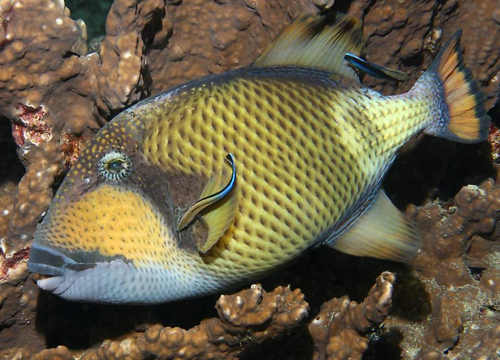
Among all triggerfishes, the queen triggerfish is a fairly large species, often reaches a total length of 45 centimeters. The female tends to be larger than male. It is oval-shaped and laterally compressed, with small eyes close to the top of its head. Despite having a small mouth, its jaw is extremely powerful and accompanied by sharp incisors. Compared to other larger triggerfishes with overlapped spread, such as grey triggerfish and ocean triggerfish, the queen triggerfish is easily recognizable with its color patterns. The body is generally steel grey to oval green, with orange parts below its mouth and pectoral fin. There are electric blue rays presented around its mouth, as well as dark blue lines radiating from its eyes. A blue line is visible at the end of the caudal fin.
Habitat

The queen triggerfish could be found in the Atlantic waters, most commonly in warmer regions. In the Western Atlantic, its range spans from Massachusetts to Brazil, as well as the Caribbean Sea. It's most common in Florida, the Bahamas and the Caribbean. While on the Eastern Atlantic, its range stretches from the Azores to Southern Angola.

Diet

The queen triggerfish feeds on a variety of prey items, mainly on sea urchins, crabs and chitons, but also occasionally preys on shrimps, snails, bivalves, small fishes and brittle stars. When feeding, it generally repeatedly bites the victim in order to crush its shell or detach it from the reef by sharp incisors. In this process, the queen triggerfish may swallow the prey and immediately spit it out. Purposes of such behavior include to repositioning the prey for further bites or removing inedible parts. However, in occasions that it is foraging a more agile and fast-swimming prey, it would simply suck the prey into its mouth.

Behaviour

The queen triggerfish generally resides in rocky seabed or coral reefs, but is occasionally found in sandy seabed or seagrass meadows. It could inhabit in water as deep as 275m, but is most commonly found in much shallower water no deeper than 30m.

Reproduction

The queen triggerfish breeds throughout the year. Larger females are thought to be capable of releasing eggs more than 80 times a year. Most breedings occur around the full moon. It often migrates to a certain breeding ground for mating. When breeding, it digs a shallow sand pit on seabed with its fin and lays eggs inside. After that, parent fishes would intensively take care of eggs and become extremely aggressive and territorial. It may use a membrane below its pectoral fins to make noise alerting other animals to stay away. After hatching, larvae are often drifted away by ocean currents. On average, male reaches maturity when 2.7 years old, while female reaches maturity at 4 years old. The maximum lifespan of the queen triggerfish is still debated.

Humans & conservation

Generally speaking, the queen triggerfish is shy toward divers and often swim away when approached. Occasionally, it may show curiosity and swim around divers. However, it is incredibly aggressive when guarding eggs and could perform a nasty bite to divers if harassed.

Part of

Where to see it

No dive sites list Queen Triggerfish yet. Explore the map to find sites near you.