
← All marine life
Queen Paua
Species IUCN · Least Concern (LC)

Queen Paua

Haliotis australis, Gmelin, 1791

marine

About Queen Paua

Haliotis australis, known by the common names queen pāua, yellowfoot pāua, silver pāua, or austral abalone, is a species of marine gastropod mollusk found in Aotearoa-New Zealand. They are edible, and often fished recreationally. Like all pāua, they are of cultural significance to the Māori, who know it by a number of names including hauwai, hihiwa, karahiwa, karariwha and korohiwa. Yellowfoot paua are harvested commercially, although not to the same extent as the blackfoot abalone.

Appearance

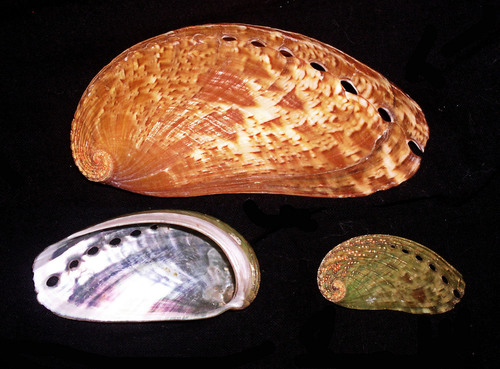
The size of the shell varies between 40 mm and 100 mm. "The thin, oval shell is quite convex. The distance of the apex from margin measures one-eighth to one-ninth the length of the shell. The sculpture consists of faint spirals and a close strong radiating corrugation. The 6 to 8 perforations are circular with elevated edges. The outlines are oval. The right margin is a little straighter. The back of the shell is convex, not carinated at the row of holes. The color pattern is light yellowish-brown, red on the spire, or light green flamed with red. The surface has almost obsolete spiral cords, and regular, close, radiating folds. Between the row of holes and the columellar margin there are no radiating folds, but several (generally three) strong spiral ribs. The spire is a little elevated and contains three whorls.
Habitat

It is endemic and widely distributed across the coasts of New Zealand. They live in shallow waters less than 10 meters deep, and can form large groups in suitable conditions.

Diet

Like other pāua, queen pāua are herbivorous. They graze on seaweeds and use their radula to scrape algae from rocks.

Behaviour

Female queen pāua lay thousands of eggs that hatch into planktonic trochophore larva. After developing a shell, the larvae sink to the ocean floor. Juveniles that land in appropriate shallow reef ecosystems can continue developing into adults. Under good conditions, they can reach full size in under 4 years. Pāua can live for 20-30 years.

Predators include tube worms, (as juveniles), seven-armed starfish, and humans.

Humans & conservation

Haliotis australis (also known as 'Queenies') and other three Haliotis species are known as "pāua" in New Zealand and are used as a food source. While generally smaller than their Haliotis iris counterparts, they are still harvested but must be a minimum length of 80mm.

Part of

Where to see it

No dive sites list Queen Paua yet. Explore the map to find sites near you.