
← All marine life
Queen Conch
Species IUCN · Near Threatened (NT)

Queen Conch

Aliger gigas, (Linnaeus, 1758)

marine

About Queen Conch

Aliger gigas, originally known as Strombus gigas or more recently as Lobatus gigas, commonly known as the queen conch, is a species of large sea snail, a marine gastropod mollusc in the family of true conches, the Strombidae. This species is one of the largest molluscs native to the Caribbean Sea, and tropical northwestern Atlantic, reaching up to 35.2 centimetres (13.9 in) in shell length. A. gigas is closely related to the goliath conch, Titanostrombus goliath, a species endemic to Brazil, as well as the rooster conch, Aliger gallus.

Appearance

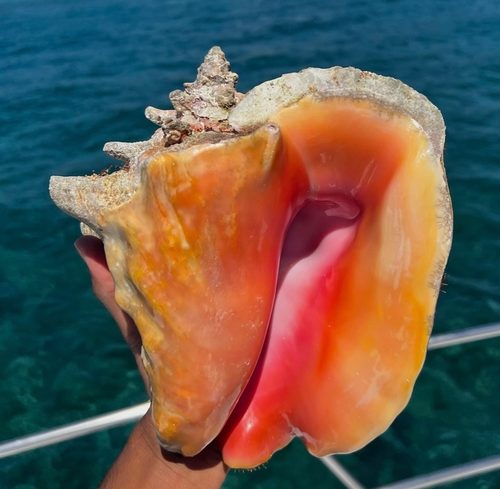
The mature shell grows to 15–31 centimetres (5.9–12.2 in) in length in three to five years while the maximum reported size is 35.2 centimetres (13.9 in). However, even though they only grow to be this maximum length, the thickness of the shell is constantly increasing. The shell is very solid and heavy, with 9 to 11 whorls and a widely flaring and thickened outer lip. The thickness is highly important because the thicker the shell, the better protected it is. Additionally, instead of increasing in size once it reaches its maximum, the outside shell thickens as time goes on- an important indicator of how old the queen conch is.
Habitat

Aliger gigas lives at depths from 0.3 to 18 m to 25–35 m. Its depth range is limited by the distribution of seagrass and algae cover. In heavily exploited areas, the queen conch is more abundant in the deepest range. The queen conch lives in seagrass meadows and on sandy substrate, usually in association with turtle grass (species of the genus Thalassia, specifically Thalassia testudinum and also Syringodium sp.) and manatee grass (Cymodocea sp.). Juveniles inhabit shallow, inshore seagrass meadows, while adults favor deeper algal plains and seagrass meadows.

The critical nursery habitats for juvenile individuals are defined by a series of characteristics, including tidal circulation and macroalgal production, which together enable high rates of recruitment and survival. A. gigas is typically found in distinct aggregates that may contain several thousand individuals.

Diet

Strombid gastropods were widely accepted as carnivores by several authors in the 19th century, a concept that persisted until the first half of the 20th century. This erroneous idea originated in the writings of Jean-Baptiste Lamarck, who classified strombids with other supposedly carnivorous snails. This idea was subsequently repeated by other authors, but had not been supported by observation. Subsequent studies have refuted the concept, proving beyond doubt that strombid gastropods are herbivorous animals. In common with other Strombidae, Aliger gigas is a specialized herbivore, that feeds on macroalgae (including red algae, such as species of Gracilaria and Hypnea), seagrass and unicellular algae, intermittently also feeding on algal detritus. The green macroalgae Batophora oerstedii is one of its preferred foods.

Behaviour

Aliger gigas is native to the tropical Western Atlantic coasts of North and Central America in the greater Caribbean tropical zone. Although the species undoubtedly occurs in other places, this species has been recorded within the scientific literature as occurring, in: Aruba (Netherlands Antilles); Barbados; the Bahamas; Belize; Bermuda; North and northeastern regions of Brazil (though this is contested); Old Providence Island in Colombia; Costa Rica; Haiti; the Dominican Republic; Panama; Swan Islands in Honduras; Jamaica; Martinique; Alacran Reef, Campeche, Cayos Arcas and Quintana Roo, in Mexico; Puerto Rico; Saint Barthélemy; Mustique and Grenada in the Grenadines; Pinar del Río, North Havana Province, North Matanzas, Villa Clara, Cienfuegos, Holguín, Santiago de Cuba and Guantánamo, in Cuba and in the Turks and Caicos Islands; South Carolina, Florida, with the Florida Keys and Flow…

Reproduction

Aliger gigas is gonochoristic, which means each individual snail is either distinctly male or distinctly female. Females are usually larger than males in natural populations, with both sexes existing in similar proportion. After internal fertilization, the females lay eggs in gelatinous strings, which can be as long as 75 feet (23 m). These are layered on patches of bare sand or seagrass. The sticky surface of these long egg strings allows them to coil and agglutinate, mixing with the surrounding sand to form compact egg masses, the shape of which is defined by the anterior portion of the outer lip of the female's shell while they are layered. Each one of the egg masses may have been fertilized by multiple males. The number of eggs per egg mass varies greatly depending on environmental conditions such as food availability and temperature.

Humans & conservation

The queen conch fishery is usually managed under the regulations of individual nations. In the United States all taking of queen conch is prohibited in Florida and in adjacent Federal waters. No international regional fishery management organization exists for the whole Caribbean area, but in places such as Puerto Rico and the Virgin Islands, queen conch is regulated under the auspices of the Caribbean Fishery Management Council (CFMC). In 2014, the Parties to the Convention for the Protection and Development of the Marine Environment of the Wider Caribbean Region (Cartagena Convention) included queen conch in Annex III of its Protocol Concerning Specially Protected Areas and Wildlife (SPAW Protocol). Species included in the Annex III require special measures to be taken to ensure their protection and recovery, and their use is authorised and regulated accordingly.

Part of

Where to see it

No dive sites list Queen Conch yet. Explore the map to find sites near you.