← All marine life
Queen Angelfish
Species IUCN · Least Concern (LC)

Queen Angelfish

Holacanthus ciliaris, (Linnaeus, 1758)

marine

About Queen Angelfish

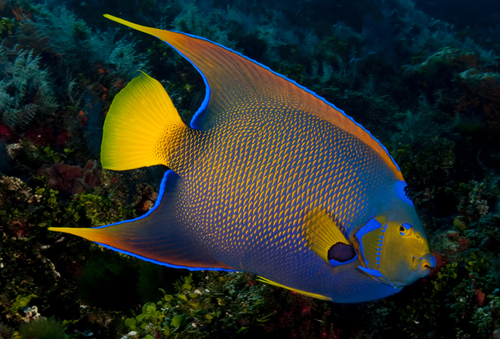
The queen angelfish (Holacanthus ciliaris), also known as the blue angelfish, golden angelfish, or yellow angelfish, is a species of marine angelfish found in the western Atlantic Ocean. It is a benthic (ocean floor) warm-water species that lives in coral reefs. It is recognized by its blue and yellow coloration and a distinctive spot or "crown" on its forehead. This crown distinguishes it from the closely related and similar-looking Bermuda blue angelfish (Holacanthus bermudensis), with which it overlaps in range and can interbreed.

Adult queen angelfish are selective feeders and primarily eat sponges. Their social structure consists of harems which include one male and up to four females. They live within a territory where the females forage separately and are tended to by the male. Breeding in the species occurs near a full moon. The transparent eggs float in the water until they hatch. Juveniles of the species have different coloration than adults and act as cleaner fish.

The queen angelfish is popular in the aquarium trade and has been a particularly common exported species from Brazil. In 2010, the queen angelfish was assessed as least concern by the International Union for Conservation of Nature as the wild population appeared to be stable.

Appearance

The queen angelfish has a broad, flattened, oval-shaped body with triangular tail fin, a reduced, dulled snout and a small mouth containing bristle-like teeth. The dorsal fin contains 14 spines and 19–21 soft rays, and the anal fin has 3 spines and 20–21 soft rays. The dorsal and anal fins both dangle behind the body. This species attains a maximum total length of 45 cm (18 in) and weight of 1,600 g (56 oz). Males may be larger than females.

Behaviour

Queen angelfish are found in tropical and subtropical areas of the Western Atlantic Ocean around the coasts and islands of the Americas. They occur from Florida along the Gulf of Mexico and the Caribbean Sea down to Brazil. Their range extends as far east as Bermuda and the Saint Peter and Saint Paul Archipelago. Queen angelfish are benthic or bottom-dwelling and occur from shallow waters close to shore down to 70 m (230 ft). They live in coral reefs, preferring soft corals, and swim either alone or in pairs.

Reproduction

Male queen angelfish have large territories with a harem of two to four females. Little is known about the sexual development of the species, though they are presumed to be protogynous hermaphrodites. The largest harem female may transform into a male if the territorial male disappears. Around midday, the females forage individually in different locations. The male tends to each of them, rushing at, circling, and feeding next to them. Spawning in this species occurs year-round. It is observed sometime around a full moon.

Humans & conservation

Queen angelfish are not normally eaten or commercially fished. They are captured mostly for the aquarium trade, where they are highly valued. As juveniles, angelfish can adapt to eating typical aquarium food and hence have a higher survival rate than individuals taken as adults, which require a more specialized diet.

In Brazil, the queen angelfish is the most common marine ornamental fish sold aboard. From 1995 to 2000, 43,730 queen angelfish were traded at Fortaleza in the northeast of the country, and in 1995, 75% of marine fish sold were both queen and French angelfish. In 2010, the queen angelfish was assessed as least concern by the International Union for Conservation of Nature, as the species is only significantly fished off Brazil and the wild population appeared to be secure.

Part of

Where to see it

No dive sites list Queen Angelfish yet. Explore the map to find sites near you.