
← All marine life
Pyjama Shark
Species IUCN · Least Concern (LC)

Pyjama Shark

Poroderma africanum, (Gmelin, 1789)

marine

About Pyjama Shark

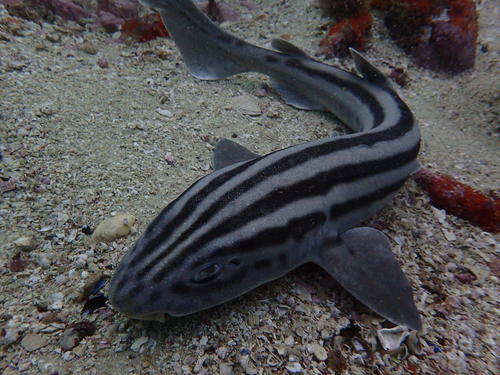
The pyjama shark or striped catshark (Poroderma africanum) is a species of catshark, and part of the family Scyliorhinidae, endemic to the coastal waters of South Africa. This abundant, bottom-dwelling species can be found from the intertidal zone to a depth of around 100 m (330 ft), particularly over rocky reefs and kelp beds. With a series of thick, parallel, dark stripes running along its stout body, the pyjama shark has an unmistakable appearance. It is additionally characterized by a short head and snout with a pair of slender barbels that do not reach the mouth, and two dorsal fins that are placed far back on the body. It can grow up to a length of 1.1 m (3.6 ft) long.

Appearance

The pyjama shark is the larger and thicker-bodied of the two Poroderma species, growing to 1.1 m (3.6 ft) long and 7.9 kg (17 lb) or more in weight. Both sexes grow to roughly the same maximum size. The head and snout are short and slightly flattened, with a narrowly parabolic outline when viewed from above or below. Each nostril is split into tiny incurrent and excurrent openings by a flap of skin in front; the flap has a three-lobed shape with the central lobe forming a long, conical barbel. The barbels are thicker than in the leopard catshark, and do not reach the mouth. The eyes are horizontally oval and placed rather high on the head, with rudimentary nictitating membranes (protective third eyelids) and a thick ridge running underneath.
Habitat

A bottom-dwelling inhabitant of temperate inshore waters, the pyjama shark is found off South Africa, from Table Bay off Cape Town to north of East London. It is most abundant off the Western Cape, and may venture as far as Saldanha Bay in the west and KwaZulu-Natal in the east; old records from Mauritius, Madagascar, and Zaire are almost certainly erroneous. The pyjama shark is commonly encountered in very shallow intertidal and littoral waters no more than 5 m (16 ft) deep, though in and around Algoa Bay it occurs at depths of 50–100 m (160–330 ft) and has been reported to 108 m (354 ft). It favors rocky reefs and beds of Ecklonia kelp.

Behaviour

Rather slow-swimming, the pyjama shark spends most of the day resting in caves or crevices or amongst kelp, emerging at night to actively forage for food. Many individuals may congregate at a single spot, particularly in summer. This species falls prey to larger sharks, and is one of the cartilaginous fish most frequently consumed by the broadnose sevengill shark (Notorynchus cepedianus). When threatened, it often curls into a circle with its tail covering its head, in a similar fashion to the shysharks (Haploblepharus). Its eggs are fed upon by the whelks Burnupena papyracea and B. lagenaria, which can pierce the outer covering to extract the yolk within. Like other sharks, the pyjama shark maintains osmotic balance with the environment by regulating its internal concentration of urea and other nitrogenous wastes.

Humans & conservation

Among the most common South African catsharks, the pyjama shark is harmless to humans and difficult to approach underwater. Because of its small size, attractive appearance, and hardiness, it is popularly exhibited by public aquariums. The aquarium trade supports a small fishery targeting this species and the similar leopard catshark. Large numbers of pyjama sharks are caught incidentally by commercial fisheries using longlines, gillnets, beach-seines, and bottom trawls; they are also readily hooked by recreational anglers, especially during the summer when they aggregate. Although edible, most are discarded while some are used for lobster bait. The toll taken by fishery bycatch is likely greatly underestimated, as many fishers who use line gear regard pyjama sharks as pests that "steal" bait, and kill them before discarding them.

Part of

Where to see it

No dive sites list Pyjama Shark yet. Explore the map to find sites near you.