
← All marine life
Puffadder Shyshark
Species IUCN · Endangered (EN)

Puffadder Shyshark

Haploblepharus edwardsii, (Schinz, 1822)

marine

About Puffadder Shyshark

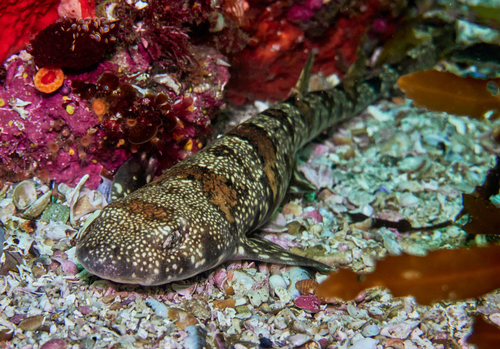
The puffadder shyshark (Haploblepharus edwardsii), also known as the Happy Eddie, is a species of shark belonging to the family Pentanchidae, the deepwater catsharks. This species is endemic to the temperate waters off the coast of South Africa. This common shark is found on or near the bottom in sandy or rocky habitats, from the intertidal zone to a depth of 130 m (430 ft). Typically reaching 60 cm (24 in) in length, the puffadder shyshark has a slender, flattened body and head. It is strikingly patterned with a series of dark-edged, bright orange "saddles" and numerous small white spots over its back. The Natal shyshark (H. kistnasamyi), formally described in 2006, was once considered to be an alternate form of the puffadder shyshark.

When threatened, the puffadder shyshark (and other members of its genus) curls into a circle with its tail covering its eyes, giving rise to the local names "shyshark" and "doughnut". It is a predator that feeds mainly on crustaceans, polychaete worms, and small bony fishes. This shark is oviparous and females deposit egg capsules singly or in pairs onto underwater structures. Harmless to humans, the puffadder shyshark is usually discarded by commercial and recreational fishers alike for its small size. It has been assessed as endangered by the International Union for Conservation of Nature (IUCN), as its entire population is located within a limited area and could be affected by a local increase in fishing pressure or habitat degradation.

Appearance

The puffadder shyshark is more slender than other shysharks, with a short, broad, dorsally flattened head and a narrowly rounded snout. The large, oval-shaped eyes have cat-like slit pupils, a simple nictitating membrane (a protective third eyelid), and a prominent ridge underneath. The nostrils are very large, with a pair of greatly expanded, triangular flaps of skin in front that are fused together and reach the mouth. There is a deep groove connecting the excurrent (outflow) opening of each nostril to the mouth, obscured by the nasal flaps. The mouth is short with furrows at the corners on both jaws. There are 26–30 tooth rows in the upper jaw and 27–33 tooth rows in the lower jaw. Tooth shape is sexually dimorphic: those of males are longer and three-pointed, while those of females are shorter and five-pointed.
Habitat

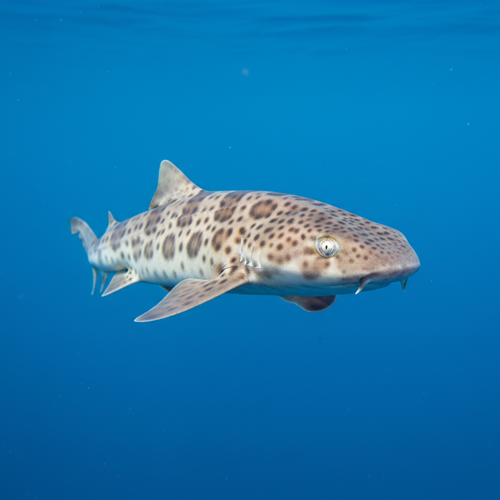
The range of the puffadder shyshark is limited to the continental shelf along the coast of South Africa, from Langebaan Lagoon in Western Cape Province to the western shore of Algoa Bay. Previous records of it being found as far north as Durban are now thought to be misidentifications of other species. This bottom-dwelling shark is most common over sandy or rocky bottoms. It is found in progressively deeper water towards the northeastern portion of its range, from 0–15 m (0–49 ft) off Cape Town to 40–130 m (130–430 ft) off KwaZulu-Natal; this distribution pattern may reflect this shark's preference for cooler waters.

Behaviour

Quite common within its small range, the sluggish and reclusive puffadder shyshark is often seen lying still on the sea floor. It is gregarious and several individuals may rest together. A generalist predator with grasping dentition, the puffadder shyshark is known to take a variety of small benthic prey: crustaceans (including crabs, shrimp, crayfish, mantis shrimp, and hermit crabs), annelid worms (including polychaetes), bony fishes (including anchovies, jack mackerels, and gobies), cephalopods (including squid), and fish offal. Overall, the most important component of this shark's diet is crustaceans, followed by polychaetes and then fishes. Males seem to prefer polychaetes, while females prefer crustaceans. It has been observed attacking a common octopus (Octopus vulgaris) by tearing off an arm with a twisting motion.

Humans & conservation

Harmless to humans, the puffadder shyshark can be easily caught by hand. Not targeted by commercial fisheries because of its small size, it is taken incidentally and discarded by bottom trawlers operating between Mossel Bay and East London, and by fishing boats in False Bay. Many are hooked by recreational anglers casting from the shore, who also generally discard or kill them as minor pests. Some local exploitation of this species does occur for lobster bait and the aquarium trade. The International Union for Conservation of Nature (IUCN) has assessed the puffadder shyshark as endangered. The small range of this shark lies entirely within a heavily fished region, and any increase in fishing activities or habitat degradation could potentially impact the entire population.

Part of

Where to see it

No dive sites list Puffadder Shyshark yet. Explore the map to find sites near you.