
← All marine life
Porbeagle
Species IUCN · Vulnerable (VU)

Porbeagle

Lamna nasus, (Bonnaterre, 1788)

marine

About Porbeagle

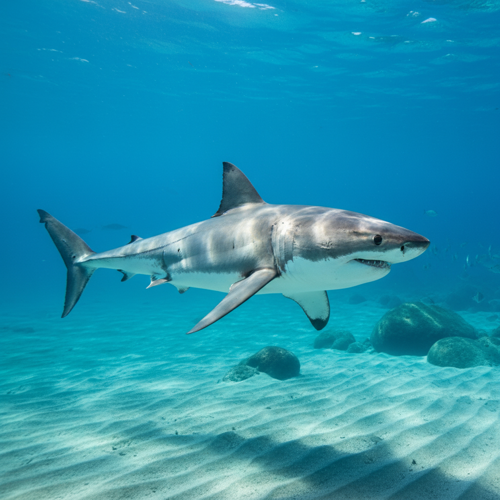
The porbeagle or porbeagle shark (Lamna nasus) is a species of mackerel shark in the family Lamnidae, distributed widely in the cold and temperate marine waters of the North Atlantic and Southern Hemisphere. In the North Pacific, its ecological equivalent is the closely related salmon shark (L. ditropis). It typically reaches 2.5 m (8.2 ft) in length and a weight of 135 kg (298 lb); North Atlantic sharks grow larger than Southern Hemisphere sharks and differ in coloration and aspects of life history. Grey above and white below, the porbeagle has a very stout midsection that tapers towards the long, pointed snout and the narrow base of the tail. It has large pectoral and first dorsal fins, tiny pelvic, second dorsal, and anal fins, and a crescent-shaped caudal fin. The most distinctive features of this species are its three-cusped teeth, the white blotch at the aft base of its first dorsal fin, and the two pairs of lateral keels on its tail.

Appearance

The porbeagle is a very stout-bodied shark with a fusiform (spindle-like) shape. The long, conical snout tapers to a sharp point, and is supported by enlarged, highly calcified rostral cartilages. The eyes are large and black, without nictitating membranes (protective third eyelids). The small, S-shaped nostrils are positioned in front of and below the level of the eyes. The mouth is large and strongly curved, with moderately protrusible jaws. North Atlantic sharks have 28–29 upper tooth rows and 26–27 lower tooth rows, while Southern Hemisphere sharks have 30–31 upper tooth rows and 27–29 lower tooth rows. Each tooth has a strongly arched base and a nearly straight, awl-like central cusp, which is flanked by a pair of smaller cusplets in all but the smallest individuals. The five pairs of gill slits are long and precede the pectoral fin bases.
Habitat

The porbeagle has an almost global amphitemperate distribution, i.e., it is absent from the tropics; in the North Pacific, where its ecological niche is assumed by the salmon shark. It is found mostly within 30–70°N and 30–50°S latitudes. In the North Atlantic, the northern limit of its range extends from the Newfoundland Grand Banks off Canada, through southern Greenland, to Scandinavia and Russia; the southern limit of its range extends from New Jersey and Bermuda, through the Azores and Madeira, to Morocco. It is found in the Mediterranean Sea, but not the Black Sea. Normally, North Atlantic sharks only stray as far south as South Carolina and the Gulf of Guinea, but pregnant females from the western North Atlantic population are known to range into the Sargasso Sea, almost as far as Hispaniola, to give birth.

Diet

The porbeagle is an active predator that predominantly ingests small to medium-sized bony fishes. It chases down pelagic fishes such as lancet fish, mackerel, pilchards, herring, and sauries, and forages near the bottom for groundfishes such as cusk, haddock, redfish (i.e., Sebastes, Lutjanus, Trachichthyidae, and Berycidae), cod, hake, icefish, dories, sand lances, lumpsuckers, and flatfish. Cephalopods, particularly squid, also form an important component of its diet, while smaller sharks such as spiny dogfish (Squalus acanthias) and tope sharks (Galeorhinus galeus) are rarely taken. Examinations of porbeagle stomach contents have also found small shelled molluscs, crustaceans, echinoderms, and other invertebrates, which were likely ingested incidentally, as well as inedible debris such as small stones, feathers, and garbage fragments.

Behaviour

Fast and energetic, the porbeagle can be found singly or in groups. Its fusiform body, narrow caudal peduncle with lateral keels, and crescent-shaped tail are adaptations for efficiently sustaining speed, which have also been independently evolved by tunas, billfishes, and several other groups of active fishes. The salmon shark and it are the thickest-bodied members of their family (length-depth ratio approaching 4.5), and consequently have the stiffest swimming style; they oscillate their tails while holding their bodies mostly rigid, which confers propulsive power with high energy efficiency, but at the cost of maneuverability. The large gill surface area of the porbeagle allows more oxygen to be delivered to its tissues.

Humans & conservation

The porbeagle has very rarely, if ever, bitten swimmers or boats. As of 2009, the International Shark Attack File attributes three bites to this species, one provoked and none fatal, and two on boats. One older anecdote tells of a fisherman who provoked a porbeagle into leaping from the water and tearing his clothes. In another account of a swimmer bitten by a "mackerel shark", the species responsible could easily have been a misidentified shortfin mako or great white shark. Recently in the North Sea, adult porbeagles have been filmed charging at divers working on oil platforms, sometimes even brushing lightly against them without doing harm. These rushes do not appear to have predatory intent and may instead be motivated by curiosity or defense.

Part of

Where to see it

No dive sites list Porbeagle yet. Explore the map to find sites near you.