
← All marine life
Pinto Abalone
Species IUCN · Endangered (EN)

Pinto Abalone

Haliotis kamtschatkana, Jonas, 1845

marine

About Pinto Abalone

Haliotis kamtschatkana, common name the northern abalone, threaded abalone, or pinto abalone, is a species of large sea snail, a marine gastropod mollusc in the family Haliotidae, the abalone.

It has been listed as endangered by the IUCN Red List of Endangered Species since 2006.

Appearance

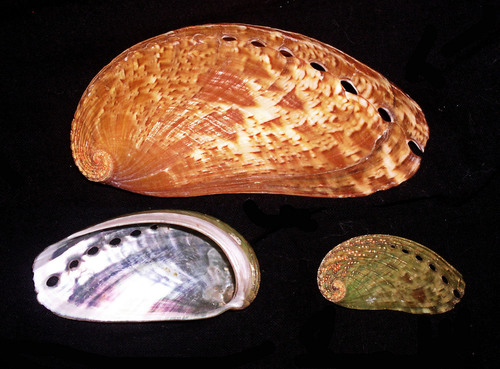
The pinto abalone has an adult shell size of approximately 8 cm (3.1 in) but it can rarely grow as large as 15 cm (5.9 in). The rather thin shell is flattened and ear-shaped. The surface is covered with uneven spiral cords, often very indistinct, and strongly elevated undulations or lumps. The columellar shelf is narrow, flattened, and sloping inward. The shell has 3 to 6 elevated respiratory holes. These holes collectively make up what is known as the selenizone which form as the shell grows. The silvery interior of the shell is iridescent. The shell is generally green-brown but can have white or blue coloration and has a somewhat scalloped edge. The epipodium is lacy and green-brown in color. Tentacles surrounding the foot and extending out of the shell sense food and predators.
Habitat

Pinto abalone are found in kelp beds and in rocky areas in the northeast Pacific Ocean, where they range from Salisbury Sound, Alaska, along the coasts of Canada and contiguous United States to Baja California, Mexico. This is the Pacific abalone species with the widest latitudinal distribution in North America.

Reproduction

They broadcast spawn from April to June. Larval dispersal is limited. Lifespan is about 15 years.

Humans & conservation

In California, Pinto abalone were never a major component of recreational or commercial catch. There was however a 10-fold decline in abundance in northern California. (156,000 in 1971 to 18,000 in 1999–2001)

In Alaska, peak harvest was between 1978 and 1981 (260,000 lbs); average harvest declined to 50,000 lbs in 1994. The commercial fishery was closed in 1996; recreational free-diving fishery remains.

In Washington State, there was no historical commercial fishing; the recreational fishing closed in 1994 due to declines in abundance. Surveys in the San Juan Islands indicate a decline in density at many sites. Densities at all but one site are below or within the minimum range for successful fertilization. Abalone size has increased between 1996 and 2006 but abundance has not.

Part of

Where to see it

No dive sites list Pinto Abalone yet. Explore the map to find sites near you.