
← All marine life
Pineapple Sea Cucumber
Species IUCN · Endangered (EN)

Pineapple Sea Cucumber

Thelenota ananas, (Jaeger, 1833)

marine

About Pineapple Sea Cucumber

Thelenota ananas, also known as pineapple sea cucumber, oloturia ananas, tripang, prickly skin cucumber, pointed teat sea cucumber, armoured sea cucumber, giant sea cucumber, sand fish or prickly redfish, is a species of sea cucumber found in tropical Indo-Pacific waters from the Red Sea and East Africa to Hawaii, Polynesia, the Maldives and Australia.

Appearance

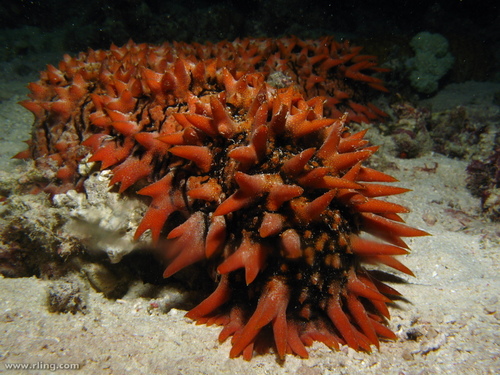
Thelenota ananas (pineapple sea cucumber) is a species of sea cucumber characterized by its large size, warm colors, and pointed, star-shaped, spotted teats covering the entire body, grouped in rows of 2 or 3, as seen in Figure 1. Their body is reddish-orange in color, with the teats slightly darker. They are able to reach up to 70 cm (28 in) in length, with a weight of between 3–6 kg (6.6–13.2 lb), and have numerous large tube feet on the flat ventral side of their body. T. ananas is a slow growing organism.

Diet

T. ananas is one of the most popular edible sea cucumber species consumed in China, and some other Southeast Asian countries. Consumption of T. ananas provides health benefits such as antioxidants, anti-inflammatory, anti-tumor, anti-proliferative, anti-coagulant, and anti-viral effects. Furthermore, sea cucumbers contain saponins, which can help regulate cholesterol metabolism, alleviate the development of obesity, hyperlipidemia, and diabetes.

Behaviour

T. ananas are widely distributed, but tracking these organisms in a non-invasive and accurate way is somewhat difficult. Mark and recapture methods can be difficult because their bodies are extendable, so measuring their body has proven difficult to scientists since the numbers are ever-changing. The body wall of T. ananas cannot be tagged because it affects the growth of the organism, and are later shed off altogether. Scratching marks into the body wall induces short-term trauma and does not last long enough for mark and recapture efforts. These methods all harm T. ananas in some form, so the best non-invasive way to track their growth and traveling is through photographs.

Part of

Where to see it

No dive sites list Pineapple Sea Cucumber yet. Explore the map to find sites near you.