
← All marine life
Pharaoh Mussel
Species

Pharaoh Mussel

Brachidontes pharaonis, (P. Fischer, 1870)

marine

About Pharaoh Mussel

Brachidontes pharaonis is a species of mussel from the family Mytilidae. It is native to the Indian Ocean and the Red Sea, and has colonised the Mediterranean Sea where it is regarded as an invasive species.

Appearance

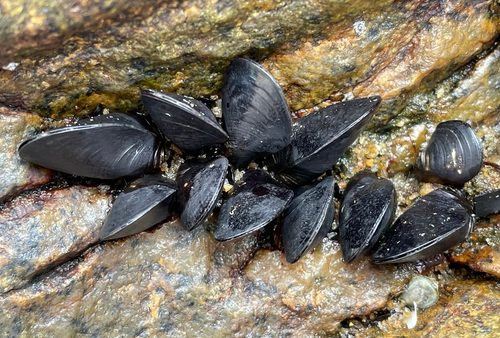
Brachidontes pharaonis is a small bivalve that grows its shell up to 40mm in length. The external surfaces of the shell are dark brownish black while the interior of the shell is purplish-black. The two halves of the shell are equal in size and similar in shape, being elongated and asymmetrical, with a dysodont hinge between the valves. The sculpture of the valves consists of numerous fine radial bifurcating ribs, which become coarser posteriorly and finely scalloped towards the edge. The outline is mytiliform with a terminal umbo, but the shape is very variable and specimens may be highly expanded posteriorly, occasionally curved; sometimes almost cylindrical with the beaks being sub-terminal. The animal is attached to the substrate by thick byssus.
Habitat

Brachidontes pharaonis is found on rocky substrates and man made structures in the intertidal zone. They appear to be able to tolerate wide temperature variations in their invasive Mediterranean range, but low winter temperatures may inhibit their physiology. In the cooler waters of the western Mediterranean, B. pharaonis is restricted to habitats with higher temperatures and salinities, where it establishes dense mussel beds on hard substrates, especially where it is sheltered from waves.

Diet

A species of whelk, Stramonita haemastoma, was found to preferentially prey on B. pharaonis off the coast of Israel and in the south of Italy.

Reproduction

There are two sexes. The sperm and eggs are released into the water column by the adults. There are two larval stages: a trochophore stage which lasts around 24 hours, and a veliger stage which lasts for some weeks before they achieve competence and settle on the substrate.

Part of

Where to see it

No dive sites list Pharaoh Mussel yet. Explore the map to find sites near you.