
← All marine life
Pearly Razorfish
Species IUCN · Least Concern (LC)

Pearly Razorfish

Xyrichtys novacula, (Linnaeus, 1758)

marine

About Pearly Razorfish

The pearly razorfish (Xyrichtys novacula), also known as the cleaver wrasse, is a species of wrasse found in the Atlantic Ocean and the Mediterranean Sea. It is of minor importance to local commercial fisheries and is popular as a game fish. It can also be found in the aquarium trade.

Appearance

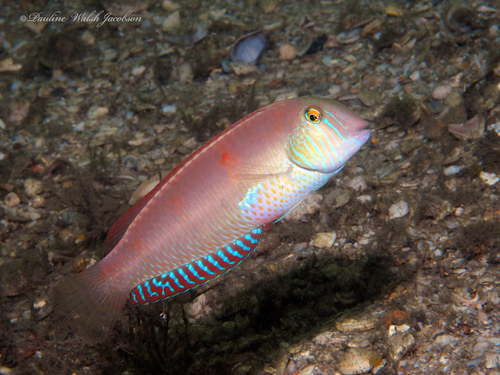
The pearly razorfish can reach 38 cm (15 in) in total length, though most individuals do not exceed 20 cm (7.9 in). Its body is elongated and very compressed laterally, and the head is flattened, with a steep profile and sharp teeth. Its long dorsal fin extends along most of its back. It has 9 dorsal spines, 12 dorsal soft rays, 3 anal spines and 12 anal soft rays. The pearly razorfish has a yellow-orange or reddish-pink color that is darker on the back and lighter on the belly, sometimes marked with green and gray stripes. The head shows bluish vertical lines and there are scales with brisk reflexes on the abdomen.

Upon capture, this fish is known to turn its mouth and sharp protruding teeth past 90 degrees to either side in relationship to its body in an attempt to be released from capture.

Habitat

The pearly razorfish is widespread throughout the subtropical and tropical Atlantic Ocean; it also occurs in the Mediterranean Sea. It inhabits clear, shallow littoral areas with sandy or muddy bottoms, at depths of 1–20 m. In winter it migrates to greater depths, up to 90–150 m.

Diet

The pearly razorfish feeds on small invertebrates such as crustaceans, mollusks and echinoderms. It can bury itself rapidly in the bottom when disturbed.

Part of

Where to see it

No dive sites list Pearly Razorfish yet. Explore the map to find sites near you.