
← All marine life
Peacock Wrasse
Species IUCN · Least Concern (LC)

Peacock Wrasse

Symphodus tinca, (Linnaeus, 1758)

marinebrackish

About Peacock Wrasse

The East Atlantic peacock wrasse (Symphodus tinca) is a species of wrasse native to the eastern Atlantic Ocean from Spain to Morocco and in the coastal waters of the Mediterranean Sea and the Black Sea. This species lives around rocks surrounded by eelgrass and can also be found in brackish waters in lagoons. It occurs at depths from 1 to 50 m (3.3 to 164.0 ft). This species can reach 44 cm (17 in) in standard length, though most grow no larger than 25 cm (9.8 in). This species is sought as a game fish and is also important to local peoples as a food fish. It can also be found in the aquarium trade.

Appearance

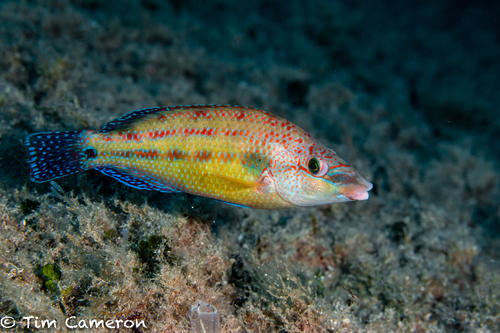
Body is oval and laterally flattened. Mouth is rather small, more or less protrusive, with rather strong canine-like teeth. There are a few cephalic pores on the snout; lips are with 6–9 folds.

Head is generally longer than body depth. Dorsal fin is very long and reaches almost to the tail. Both sexes have a small dark spot at base of caudal fin and a dark blotch just above pectoral fin. Also, many darker spots on the body form 3 or 4 longitudinal stripes.

Generally, color reflects sexual dimorphism. Females and juveniles are grey-greenish or brownish, fading to a silvery color on the belly. Between immature males and mature females there are almost no differences in color. Males are more brightly colored, especially in the breeding season. Pale green, green-bluish or green-yellowish, longitudinal rows of red spots, with upper part of head dark blue.

Habitat

It is native to the eastern Atlantic Ocean from Spain to Morocco and can be found in the coastal waters of the Mediterranean Sea and the Black Sea.

This gregarious littoral fish is found on rocky reefs covered by algae, on sea-grass meadows, around rocks surrounded by eelgrass and can also be found in brackish waters in lagoons. It occurs at depths from 1 to 50 m (3.3 to 164.0 ft).

Part of

Where to see it

No dive sites list Peacock Wrasse yet. Explore the map to find sites near you.