
← All marine life
Pavona Clavus Coral
Species IUCN · Least Concern (LC)

Pavona Clavus Coral

Pavona clavus, (Dana, 1846)

marine

About Pavona Clavus Coral

Pavona clavus (common name shoulder blade coral) is a species of colonial stony coral in the family Agariciidae. It is a widespread but uncommon species known from the Indo-Pacific region, the South China Sea, the Red Sea, and the Gulf of Aden. A P. clavus colony in the Solomon Islands is considered to be the world's largest known coral.

Appearance

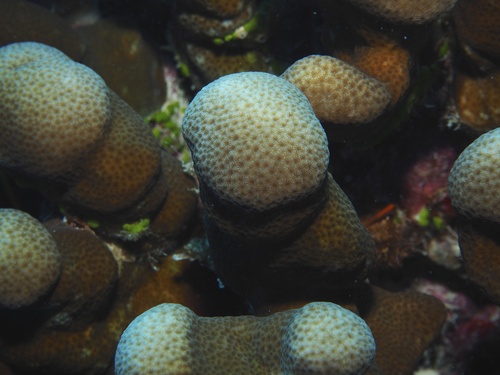
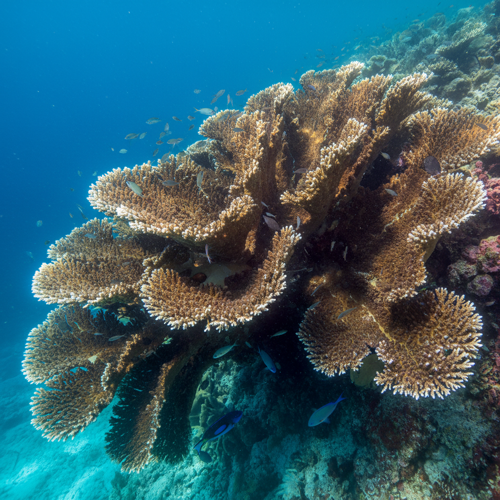
Pavona clavus is a cream, yellow, brown, or pale grey coral typically forming columnar or club-shaped colonies, though it may also form flattened plates. The columns are generally smooth and uniform in size, typically measuring up to 20 cm (7.9 in) tall and 3–5 cm (1.2–2.0 in) in diameter. They are capable of dividing but not fusing. The colonies may range from 10 cm (3.9 in) in diameter to over 10 m (33 ft) across, sometimes forming extensive single-species stands.

The corallites of this species are circular and very small, measuring 2.5–3.5 mm (0.098–0.138 in) in diameter, with thick, well defined walls. The corallites may be arranged irregularly or in short valleys.

Flattened colonies of P. clavus may resemble P. bipartita, and the corallites are similar to those of P. duerdeni.
Habitat

Pavona clavus is typically found on coral reefs at depths of 2–40 m (6 ft 7 in – 131 ft 3 in), often on slopes and in areas exposed to currents. It prefers protected or semi-protected habitats and is absent from very shallow, high energy reef platforms.

Behaviour

Pavona clavus is a reef-building species that grows at rates of 0.9–1.3 cm (0.35–0.51 in) per year. It is a preferred prey species of the crown-of-thorns starfish (Acanthaster planci) and one of two known host species of the gall crab Opecarcinus cathyae.

Humans & conservation

Pavona clavus is listed as least concern on the International Union for the Conservation of Nature's Red List. Though coral reefs are declining globally, P. clavus is widely distributed and expected to decline by less than 25% by 2050. In some parts of its range it is known to bleach easily, but it appears to be more resilient in other areas. It is threatened by climate change, coral diseases, dynamite fishing, human development activities (including industrial, commercial, and housing development), invasive species, pollution, sedimentation, shipping, and tourism.

The trade of this species, and all other stony corals, is regulated under Appendix II of the CITES treaty.

Part of

Where to see it

No dive sites list Pavona Clavus Coral yet. Explore the map to find sites near you.