
← All marine life
Palette Surgeonfish
Species IUCN · Least Concern (LC)

Palette Surgeonfish

Paracanthurus hepatus, (Linnaeus, 1766)

marine

About Palette Surgeonfish

Paracanthurus hepatus is a species of Indo-Pacific surgeonfish. A popular fish in marine aquaria, it is the only member of the genus Paracanthurus.

A number of common names are attributed to the species, including palette surgeonfish, blue surgeonfish, blue tang (leading to confusion with the Atlantic species Acanthurus coeruleus), flagtail surgeonfish, hepatus tang, Indo-Pacific bluetang, regal blue surgeonfish, wedge-tailed tang, wedgetail blue tang, royal blue tang, hippo tang, blue hippo tang, regal tang, and regal blue tang.

It is most closely related to genus Zebrasoma, with which it forms a sister group.

Appearance

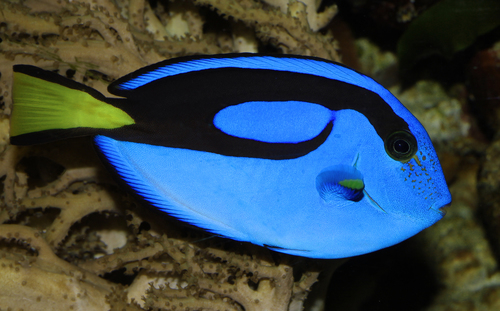
Paracanthurus hepatus has a royal blue body, yellow tail, and black "palette" design. Its length at first sexual maturity is 149.2 mm. Adults typically weigh around 600 g (21 oz) and males are generally larger than females. The back has a broad black area that encloses at the tip of the pectoral, creating a blue oval on each side of the fish that extends in the direction of the eye. The tail has a bright yellow triangle with its apex anterior to the caudal spine and its base at the posterior end of the caudal fin. Black surrounds the triangle on the upper and lower lobes of the caudal fin, in the same hue as the back area.
Habitat

The regal blue tang can be found throughout the Indo-Pacific. It is seen in the reefs of the Philippines, Indonesia, Japan, the Great Barrier Reef of Australia, New Caledonia, Samoa, East Africa, and Sri Lanka. A single specimen was photographed in 2015 in the Mediterranean Sea off Israel. Vagrants were found on two occasions in Hawaii, and are assumed to be aquarium releases.

Diet

As a juvenile, its diet consists primarily of plankton. Adults are omnivorous and feed on zooplankton, but will also graze on filamentous algae, microalgae and other marine plants.

Behaviour

Paracanthurus is a diurnal marine species that occupies marine neritic habitats along coastlines. It is found in clear water on exposed outer reef areas or in channels with a moderate or strong current. It primarily utilizes coral reef habitats, but is also known to utilize seagrass beds, mangroves, algal beds, and rocky reefs [1]. It has an upper and lower depth limit of 2 meters and 40 meters, respectively . They live in pairs or small groups of 8 to 14 individuals. They can also be found near cauliflower corals on the seaweed side of coral reefs. Juveniles can be found in schools using Acropora for shelter. Numbers of males and females tend to maintain a 1:1 ratio.

The fish is important for coral health, as it eats algae that may otherwise choke it by overgrowth.

Reproduction

Spawning takes place year round, with a peak between April and September. Spawning occurs during late afternoon and evening hours around outer reef slopes. This event is indicated by a change in color from a uniform dark blue to a pale blue. Males aggressively court female members of the school, leading to a quick upward spawning rush toward the surface of the water during which eggs and sperm are released. The eggs are small, approximately 0.8 millimetres (1⁄32 in) in diameter. The eggs are pelagic, each containing a single droplet of oil for flotation. The fertilized eggs hatch in twenty-four hours, revealing small, translucent larvae with silvery abdomens and rudimentary caudal spines. Once opaque, the black "palette" pattern on juveniles do not fully connect until mature. These fish reach sexual maturity at 9–12 months of age, and at approximately 149.22 mm in size.

Humans & conservation

The regal blue tang is of minor commercial fisheries importance; however, it is a bait fish. The flesh has a strong odor and is not highly prized. This fish may cause ciguatera poisoning if consumed by humans. However, regal blue tangs are collected commercially for the aquarium trade. Handling the tang risks the chances of being badly cut by the caudal spine. These spines, one on each of the two sides of the caudal peduncle, the area where the tail joins the rest of the body, are extended when the fish is stressed. The quick, thrashing sideways motion of the tail can produce deep wounds that result in swelling and discoloration, posing a risk of infection. It is believed that some species of Acanthurus have venom glands while others do not. The spines are used only as a method of protection against aggressors.

Part of

Where to see it

No dive sites list Palette Surgeonfish yet. Explore the map to find sites near you.