
← All marine life
Oyster
Group

Oyster

About Oyster

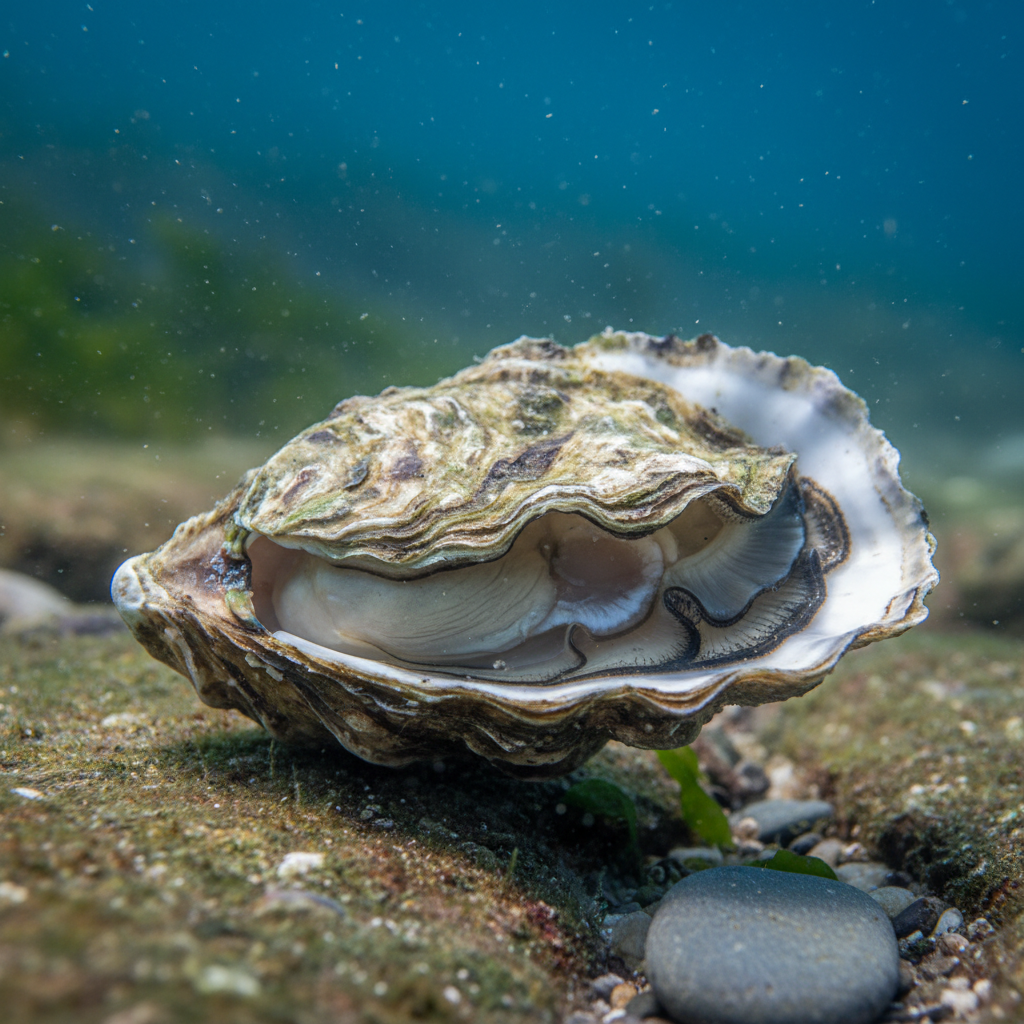
Oyster is the common name for a number of different families of salt-water bivalve molluscs that live in marine or brackish habitats. In some species, the valves are highly calcified, and many are somewhat irregular in shape. Many (but not all) oysters are in the superfamily Ostreoidea.

Some species of oyster are commonly consumed and are regarded as a delicacy in some localities. Some types of pearl oysters are harvested for the pearl produced within the mantle. Others, such as the translucent windowpane oysters, are harvested for their shells.

Appearance

Oysters breathe primarily via gills. In addition to their gills, oysters can exchange gases across their mantles, which are lined with many small, thin-walled blood vessels. A small, three-chambered heart, lying under the adductor muscle, pumps colorless blood to all parts of the body. At the same time, two kidneys, located on the underside of the muscle, remove waste products from the blood. Their nervous system includes two pairs of nerve cords and three pairs of ganglia. There is no evidence that oysters have a brain.

While some oysters have two sexes (European oyster and Olympia oyster), their reproductive organs contain both eggs and sperm. Because of this, it is technically possible for an oyster to fertilize its own eggs. The gonads surround the digestive organs, and are made up of sex cells, branching tubules, and connective tissue.

Habitat

A group of oysters is commonly called a bed or oyster reef.

Oysters are filter feeders, taking in large amounts of water to feed and breathe (exchange O2 and CO2 with water) but they are not permanently open. They regularly shut their valves to enter a resting state, even when they are permanently submersed. Their behaviour follows very strict circatidal and circadian rhythms according to the relative moon and sun positions. During neap tides (the time periods of mildly shifting tides), they exhibit much longer closing periods than during the spring tide (the time period of more drasticly shifting tides).

Diet

Oysters are filter feeders, drawing water in over their gills through the beating of cilia. Suspended plankton and non-food particles are trapped in the mucus of a gill, and from there are transported to the mouth, where they are eaten, digested, and expelled as feces or pseudofeces that fall to the bottom and remain out of the water column. Oysters feed most actively at temperatures ranging from the high 60s (°F) to the high 70s (°F) (20–26 °C). Under ideal laboratory conditions, an oyster can filter up to 190 L (50 US gal) of water per day. Under average conditions, mature oysters filter 11–45 L (3–12 U.S. gal). Chesapeake Bay's once-flourishing oyster population historically filtered excess nutrients from the estuary's entire water volume every three to four days. As of 2008 it was estimated that a complete cycle would take nearly a year.

Reproduction

Oysters usually reach maturity in one year. They are protandric; during their first year, they spawn as males by releasing sperm into the water. As they grow over the next two or three years and develop greater energy reserves, they spawn as females by releasing eggs. Bay oysters usually spawn from the end of June until mid-August. An increase in water temperature prompts a few oysters to spawn. This triggers spawning in the rest, clouding the water with millions of eggs and sperm. A single female oyster can produce up to 100 million eggs annually. The eggs become fertilized in the water and develop into larvae, which eventually find suitable sites, such as another oyster's shell, on which to settle. Attached oyster larvae are called spat. Spat are oysters less than 25 mm (1 in) long. Many species of bivalves, oysters included, seem to be stimulated to settle near adult conspecifics.

Humans & conservation

Middens testify to the prehistoric importance of oysters as food, with some middens in New South Wales, Australia, dated at ten thousand years. They have been cultivated in Japan from at least 2000 BC. In the United Kingdom, the town of Whitstable is noted for oyster farming from beds on the Kentish Flats that have been used since Roman times. The borough of Colchester holds an annual Oyster Feast each October, at which "Colchester Natives" (the native oyster, Ostrea edulis) are consumed. The United Kingdom hosts several other annual oyster festivals; for example, Woburn Oyster Festival is held in September. In fact, in Victorian England, it was quite common for people to go to the pub and enjoy their favorite beer with some oysters. They quickly realized that the "rich, sweet, malty stouts" were great with the "briny, creamy oyster".

Species in this group

Where to see it

No dive sites list Oyster yet. Explore the map to find sites near you.

Sources

  • Wikipedia — licensed CC BY-SA 4.0 · Text adapted from the Wikipedia article; modifications by WikiBubbles are shared under the same license.