
← All marine life
Orangestripe Triggerfish
Species IUCN · Least Concern (LC)

Orangestripe Triggerfish

Balistapus undulatus, (Park, 1797)

marine

About Orangestripe Triggerfish

The orange-lined triggerfish (Balistapus undulatus), also known as the orangestripe triggerfish, red-lined triggerfish, striped triggerfish or vermiculated triggerfish, is a species of marine ray-finned fish belonging to the family Balistidae, the triggerfishes. This species is the only species in the monospecific genus Balistapus, which is closely related to the genus Balistoides, if that genus is reclassified as a monospecific genus with the clown triggerfish as its only species. The orange-lined triggerfish has a wide Indo-Pacific range.

Appearance

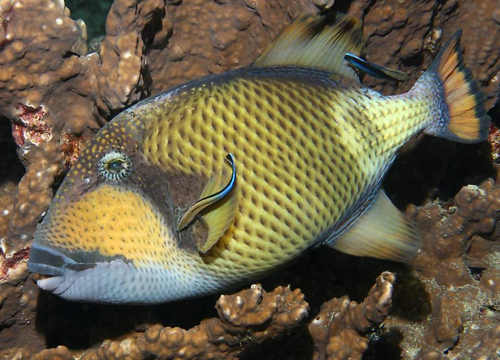
The orange-lined triggerfish has a dark brown to dark green body with orange lines that start behind the head and cover the rest of its body. Their maximum body size is about 30 centimeters. Its body has a stocky appearance, oval shape, and is compressed laterally. The head is large and is about one third of the body length. The mouth is small and terminal and it has strong teeth.

The first dorsal fin has three spines, one of which is longer and stronger than the other. It is erectile and kept in a dorsal furrow at rest. The second dorsal fin is similar in shape and size to the anal fin, which is symmetrically opposed to it. The pelvic fin is reduced to a ventral protrusion. They also typically have a large block spot by their peduncular spines, and the caudal fin is orange.
Habitat

While other balistoid fishes, such as the filefish and leatherjacks, are typically found all across the Indo-western Pacific, the triggerfish are typically found in coral reefs ecosystems, coral lagoons, and external reef slopes within this area, as well off the coast of East Africa, the Red Sea, and Japan. They tend to stay around their burrows and dens within the reef. Within coral reefs, the orange-lined triggerfish are more versatile than other triggerfish species and can be found at depths up to 50 meters, although studies have found that they prefer depths of 2 to 8 meters. No relationship between the area of the reef and depth has been found in juveniles, and adults were found to vary their depth based on the region; in general, the species was found to have a broad distribution across the reef.

Diet

The orange-lined triggerfish is an omnivorous feeder that can, because of its strong and heavy teeth, tackle a variety of benthic prey. Observed food items include cnidarians, molluscs, ctenophores, crustaceans, other fish, algae, and echinoderms. This species in particular, given its broad diet and distribution, is a crucial component in coral reef ecosystems through top-down control and especially through consumption of sea-urchins. The orange-lined triggerfish is a main and dominant predator of the burrowing urchin (Echinometra mathaei) in East African marine parks. Before being protected, the population was overfished, which allowed the burrowing sea urchin population to grow rapidly. In these ecosystems, the burrowing sea urchin affects coral reef health, the presence of other grazers and algae, and erosion.

Behaviour

The orange-lined triggerfish prefers parts of the reef where there are a lot of places to hide and are able to slide sideways into crevices or small openings to evade predation. Typically encountered as solitary fishes, their territory may overlap multiple female territories which are defended against intruding congeners. Once the female has accepted the male, the eggs are deposited on the substrate for the male to fertilise. The female then guards the eggs from predators. Triggerfish have a varied diet consisting of algae, sponges, crustaceans, molluscs, algae, sea urchins, tunicates, worms, fish eggs and detritus.

Part of

Where to see it

No dive sites list Orangestripe Triggerfish yet. Explore the map to find sites near you.