
← All marine life
Opah
Species IUCN · Least Concern (LC)

Opah

Lampris guttatus, (Brünnich, 1788)

marine

About Opah

Lampris guttatus, commonly known as the opah, cravo, moonfish, kingfish, and Jerusalem haddock, is a large, colorful, deep-bodied pelagic lampriform fish belonging to the family Lampridae, which comprises the genus Lampris.

It is a pelagic fish with a worldwide distribution. While it is common to locations such as Hawaii and west Africa, it remains uncommon in others, including the Mediterranean.

In the places where L. guttatus is prevalent, it is not a target of fishing, though it does represent an important commercial component of bycatch. It is common in restaurants in Hawaii. In Hawaiian longline fisheries, it is generally caught in deep nets targeting bigeye tuna. In 2005, the fish caught numbered 13,332. In areas where the fish is uncommon, such as the Mediterranean, its prevalence is increasing. Some researchers believe this a result of climate change.

Much is still unknown about the distribution, interactions, life histories, and preferred habitats of this fish and other medium to large-sized pelagic fishes.

Appearance

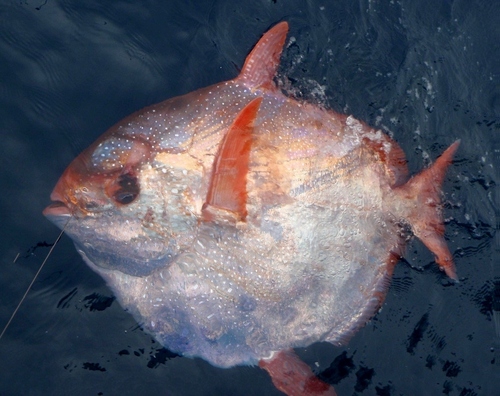
Lampris guttatus is a large discoid and deeply keeled fish with a conspicuous coloration. They can reach a maximum length of 2 m (6.6 ft) and a maximum weight of 86 kg (190 lb), although there are reports of the fish reaching up to 270 kg (600 lb). The body is a deep steely blue grading to rosy on the belly, with white spots in irregular rows covering the flanks. Both the median and paired fins are a bright vermillion. Jaws are vermillion, too. The large eyes stand out as well, ringed with golden yellow. The body is covered in minute cycloid scales and its silvery, iridescent guanine coating is easily abraded.

Habitat

Lampris guttatus has a worldwide distribution, from the Grand Banks to Argentina in the Western Atlantic, from Norway and Greenland to Senegal and south to Angola in the Eastern Atlantic (also in the Mediterranean), from the Gulf of Alaska to southern California in the Eastern Pacific, in temperate waters of the Indian Ocean, and rare forays into the Southern Ocean.

Behaviour

The life history and development of L. guttatus remains rather uncertain. They are apparently solitary, but are known to school with tuna and other scombrids. They propel themselves by a lift-based mode of swimming using their pectoral fins. This, together with their forked caudal fins and depressible median fins, indicates that they swim at constantly low speeds. They are able to swim at over 25 cm/s, and one was even observed reaching 4 m/s (14 km/h; 8.9 mph) in a burst of speed.

Like many other large pelagic visual predators, such as swordfish and big-eye tuna, they exhibit vertical behavior. Based on those caught off the Hawaiian coast, squid and krill make up the bulk of their diet, though they also consume small fish. Those caught along the Patagonian Shelf also showed a narrow range of prey, the most common of which was the deepwater onychotenhid squid (Moroteuthis ingens).

Humans & conservation

L. guttatus is often regarded as a secondary target in commercial fisheries, and is taken incidentally while longline fishing for other pelagic species like tuna. It has been described to have a rich and creamy flavor, and are commonly used in sashimi.

Where to see it

No dive sites list Opah yet. Explore the map to find sites near you.