← All marine life
Oceanic Whitetip Shark
Species IUCN · Critically Endangered (CR)

Oceanic Whitetip Shark

Carcharhinus longimanus, (Poey, 1861)

marine

About Oceanic Whitetip Shark

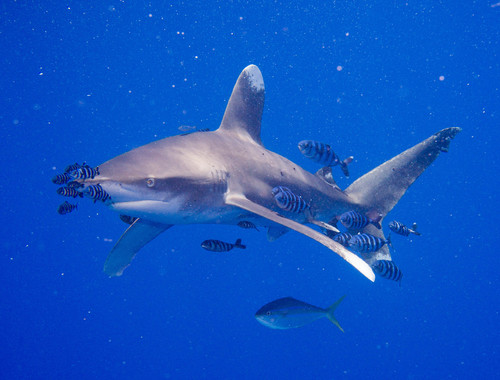
The oceanic whitetip shark (Carcharhinus longimanus) is a large requiem shark inhabiting the pelagic zone of tropical and warm temperate seas. It has a stocky body and iconic elongated rounded fins, with white tips. The species is typically solitary, though they may gather in large numbers at food concentrations. Bony fish and cephalopods are the main components of its diet and females give live birth.

Though slow-moving, the shark is opportunistic and aggressive, and is reputed to be dangerous to shipwreck survivors. The IUCN Red List considers the species to be critically endangered. As with other shark species, the whitetip faces mounting fishing pressure throughout its range, with recent studies show steeply declining populations as they are harvested for their fins and meat.

Appearance

C. longimanus' most distinguishing characteristics are its long, wing-like pectoral and dorsal fins. The fins are significantly larger than most other shark species, and have conspicuously rounded tips. The shark's snout is rounded and its eyes are circular, with nictitating membranes.

Habitat

This shark is found worldwide between 45°N and 43°S latitude. It lives in deep, open oceans, with a temperature greater than 18 °C (64 °F), It prefers water temperatures above 20 °C (68 °F), and up to 28 °C (82 °F) but can also be found in waters as cool as 15 °C (59 °F) but avoids temperatures lower than this. It was once extremely common and widely distributed, and still inhabits a wide band around the globe; however, recent studies suggest that its numbers have drastically declined.

The shark spends most of its time in the upper layer of the ocean—to a depth of 150 m (490 ft)—and prefers off-shore, deep-ocean areas. According to longline capture data, increasing distance from land correlates to a greater population of sharks. It is sometimes found close to land, in waters as shallow as only 37 m (120 ft) deep, mainly around oceanic islands and narrow continental shelves.

Reproduction

Mating and birthing seems to occur in early summer in the northwest Atlantic Ocean and southwest Indian Ocean, although females captured in the Pacific have been found with embryos year round, suggesting a longer mating season there. The shark is viviparous—embryos develop in utero and are fed by a placental sac. Its gestation period lasts nine months to one year. In the northwest Atlantic, shark pups are born 65–75 cm (26–30 in) long while off South Africa, birth length is 60–65 cm (24–26 in) long. In the Pacific Ocean, newborns average 45–55 cm (18–22 in) long, and number two to fourteen per litter.

Humans & conservation

Until the 16th century, sharks were known to mariners as "sea dogs" and the oceanic whitetip the most common ship-following shark. Oceanographic researcher Jacques Cousteau described the oceanic whitetip as "the most dangerous of all sharks". Author and big-game fisherman Ernest Hemingway depicted them as aggressive opportunists that attacked the catch of fishermen in The Old Man and the Sea, which may be based on Hemingway's experience fishing from his boat, the Pilar.

Where to see it

No dive sites list Oceanic Whitetip Shark yet. Explore the map to find sites near you.