
← All marine life
Oceanic Triggerfish
Species IUCN · Least Concern (LC)

Oceanic Triggerfish

Canthidermis maculata, (Bloch, 1786)

marine

About Oceanic Triggerfish

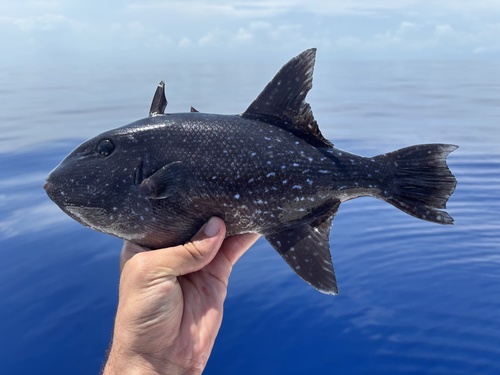
Canthidermis maculata, also known as rough triggerfish or spotted oceanic triggerfish, is a species of triggerfish native to the tropical and subtropical oceans worldwide. Unlike most triggerfish, they are mostly pelagic.

In the Philippines, the species is locally called Tikos in the Cebuano language and is abundant in the Visayas and Mindanao island groups.

Appearance

The maximum length for this species is 50 centimetres (20 in), but usually grows up to 35 centimetres (14 in). Adults and juveniles have different coloration. Adults are blue grayish, while juveniles are grayish black with white spots that fade over age. Adults may be seen with dark blotches appearing on the face and pectoral fins during mating. These markings are also present on females hovering above their nests, and may disappear within a few seconds once they ascend through in the water column, away from their nest (Clark et al., 2014). In this fish, the dorsal and anal fins are curved on the back. The dorsal fin of this species has from 23 to 27 rays; its first dorsal fin’s rays are spinous, with the first two rays more like sharp thorns. The smaller second thorn props up the longer first thorn, giving it the appearance of a trigger, after which the fish is named (Tupongov, 2015).
Habitat

In the western Pacific Ocean it ranges from the Gulf of Thailand north to the Yellow Sea and Japan, also extending eastward to the Philippines, Indonesia, and all the way to Polynesia and Hawaii. In the eastern Pacific Ocean, they are found from Mexico and around the Gulf of California down to Peru and the Galapagos Islands. Around the Indian Ocean, it ranges from the Red Sea and eastern Africa to the Seychelles, the Maldives, the Persian Gulf, India, Sri Lanka, the Andaman Sea, Australia, and Indonesia. Populations in the Atlantic Ocean range from New York down to the Gulf of Mexico, the Bahamas, the Caribbean Sea and down to Brazil on the western side. Around the eastern Atlantic Ocean, it ranges from the British Isles and the Bay of Biscay to the Azores, the Canary Islands and western Africa. Some populations are also found in South Africa.

Diet

Spotted oceanic triggerfish display plasticity in their eating habits, being considered either a carnivorous or a planktivorous fish. Upon examination, they have been shown to consume smaller fish, Halobates (sea skaters), Siphonophores, and smaller cartilaginous fish (Senta et al., 1993).

Behaviour

Canthidermis maculata are noted hosts of sea lice (Copepoda: Caligidae) in the Neotropical region (Morales-Serna et al., 2016). Additionally, they have been recorded as visitors of cleaning stations hosted by the black-nosed butterflyfish and the Mexican hogfish, at Malpelo Island in the tropical eastern pacific (Quimbayo et al., 2016).

Reproduction

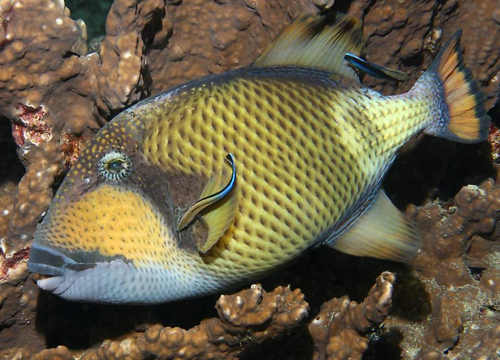
Canthidermis maculata nesting is unlikely to be impacted by lunar cycle and has been determined to occur year-round. Eggs are deposited in sand and/or coral rubble, shallowly buried beneath the sand, and are both aerated and guarded by the mother. Frequently, many nests are located near one another, supporting the idea that these triggerfish nest as a group. It is unclear how often a female nests per year and whether or not it returns to the same nest or builds new nests in its habitat range. Additionally, nests have been found at depths ranging from 4 meters to over 45 meters, with the deeper nests being considered a defensive strategy against titan triggerfish (Clark et al., 2014) which nest at shallower depths and are known to be territorial when nesting (Randall et al., 1990).

Humans & conservation

This fish species shows some importance to commercial fishing. The spotted oceanic triggerfish, like other triggerfish, is sold at local markets in coastal Asian countries as a fish to be eaten. These triggerfish are not typically fished for specifically but rather are caught as by-catch in tuna purse seine fishing and on longlines (Sethi et al., 2011; Lezama-Ochoa et al., 2016, Matsuura, 2001). Additionally, the spotted oceanic triggerfish is sold in the aquarium trade.

There have been reports of ciguatera poisoning in some humans that consumed the fish.

Fishermen living in the town of Kinniya, Sri Lanka, use this species in marine fish production.

Part of

Where to see it

No dive sites list Oceanic Triggerfish yet. Explore the map to find sites near you.