← All marine life
Ocean Sunfish
Species IUCN · Vulnerable (VU)

Ocean Sunfish

Mola mola, (Linnaeus, 1758)

marine

About Ocean Sunfish

The ocean sunfish (Mola mola), also known as the common mola, is one of the largest ray-finned fish in the world. It is the type species of the genus Mola, and one of five extant species in the family Molidae. It was formerly misidentified as the heaviest bony fish, which is actually a different and closely related species of sunfish, Mola alexandrini. Adults typically weigh between 247 and 1,000 kg (545 and 2,205 lb). It is native to tropical and temperate waters around the world. It resembles a fish head without a tail, and its main body is flattened laterally. Sunfish can be as tall as they are long, between 175 and 180 centimetres (5.74 and 5.91 ft), when their dorsal and ventral fins are extended.

Many areas of sunfish biology remain poorly understood, including mating practices and spawning locations, early life stages, movement and migration patterns, population structure and status, diet and trophic ecology, and post-release survival rates. Various research efforts are underway, including aerial surveys of populations, satellite surveillance using pop-off satellite tags, genetic analysis of tissue samples, and collection of amateur sighting data.

Adult sunfish are vulnerable to few natural predators, but sea lions, orcas, and sharks will consume them. Sunfish are considered a delicacy in some parts of the world, including Japan, Korea, and Taiwan. In the European Union, regulations ban the sale of fish and fishery products derived from the family Molidae. Sunfish are frequently caught in gillnets.

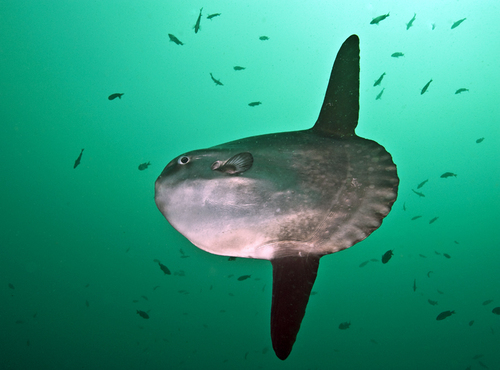
Appearance

The ocean sunfish shares many traits common to members in the order Tetraodontiformes, including pufferfish, porcupinefish, and filefish, like having a beak formed from four fused teeth; sunfish fry resemble spiky pufferfish more than they resemble adult molas.

The caudal fin of the ocean sunfish is replaced by a rounded clavus, creating the body's distinct truncated shape. The body is flattened laterally, giving it a long oval shape when seen head-on. The pectoral fins are small and fan-shaped, while the dorsal fin and the anal fin are lengthened, often making the fish as tall as it is long. Specimens up to 3.3 m (10 ft 10 in) in height have been recorded.

Habitat

Ocean sunfish are native to the temperate and tropical waters of every ocean in the world. Mola genotypes appear to vary widely between the Atlantic and Pacific, but genetic differences between individuals in the Northern and Southern hemispheres are minimal.

Diet

The diet of the ocean sunfish was formerly thought to consist primarily of various jellyfish and other gelatinous zooplankton, such as ctenophores, salps, and medusae. However, genetic analysis reveals that sunfish are actually generalist predators that consume mostly small fish (such as flounder), fish (eel) larvae, squid, other molluscs, crustaceans, and other soft-bodied invertebrates, with jellyfish and salps making up only around 15% of the diet. Occasionally, they will ingest eel grass. This range of food items indicates that the sunfish feeds at many levels, from the surface to deep water, and occasionally down to the seafloor in some areas.

Reproduction

Ocean sunfish may live up to ten years in captivity, but their lifespan in a natural habitat has not yet been determined. However, estimates of their lifespan in a natural habitat place their life expectancy at around 2 to 23 years for females and 1-16 years for males. Their growth rate also remains undetermined. However, a young specimen at the Monterey Bay Aquarium increased in weight from 26 to 399 kg (57 to 880 lb) and reached a height of nearly 1.8 m (5 ft 11 in) in 15 months.

The sheer size and thick skin of an adult of the species deters many smaller predators, but younger fish are vulnerable to predation by bluefin tuna and mahi mahi. Adults are consumed by orca, sharks and sea lions.

Humans & conservation

The ocean sunfish is listed as vulnerable by the IUCN, with its population decreasing. Its main threat is the use of drift gillnets.

Where to see it

No dive sites list Ocean Sunfish yet. Explore the map to find sites near you.