
← All marine life
Northern Seahorse
Species IUCN · Vulnerable (VU)

Northern Seahorse

Hippocampus erectus, Perry, 1810

marine

About Northern Seahorse

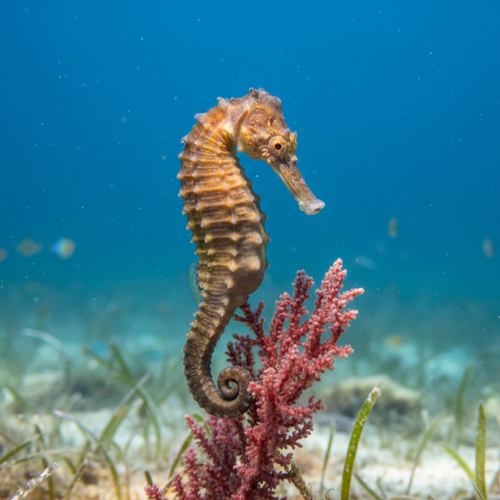
The lined seahorse (Hippocampus erectus), northern seahorse or spotted seahorse, is a species of fish that belongs to the family Syngnathidae. H. erectus is a diurnal species with an approximate length of 15 cm (5.9 inches) and lifespan of one to four years. The H. erectus species can be found in myriad colors, from greys and blacks to reds, greens, and oranges. The lined seahorse lives in the western Atlantic Ocean as far north as Cape Cod and as far south as the Caribbean, Mexico, and Venezuela. It swims in an erect position and uses its dorsal and pectoral fins for guidance while swimming.

Appearance

The lined seahorse was first named Hippocampus Erectus by George Perry in 1810. "Hippocampus" translates into "horse or sea monster" in ancient Greek. The lined seahorse is a diurnal species that ranges in length from 12 cm to 17 cm; the maximum length reported for the species is 19 cm. The seahorse is sexually dimorphic, meaning there are distinct differences in appearances of males and females; most notably the brood pouch located on the male's abdomen which it utilized in reproduction. Males are also slightly larger in size and have longer prehensile tails than the females. In the wild, the lined seahorse has a lifespan of one to four years; however, in captivity their lifespan usually reaches the full four years. Four years is the maximum age reported for the species. They have a broad color spectrum, ranging from black, grey, brown, and green, to orange, red, and yellow.
Habitat

The lined seahorse range spans from the waters to the south of Nova Scotia, to the southern area of Venezuela in South America. They can be found on the east coast of United States in Connecticut, Delaware, Florida, Georgia, Louisiana, Maryland, New Jersey, New York, Rhode Island, Virginia, and the Carolinas, as well as in the waters surrounding Mexico and the Caribbean. Species found in Brazil seem to be of a different species; however, more research is needed to determine this proposal. The lined seahorse is native to the following locations: United States, Bermuda, Cuba, Mexico (Veracruz, Yucatán), Haiti, Saint Kitts and Nevis, Belize, Honduras, Nicaragua, Costa Rica, Panama, Guatemala, and Venezuela. It has also been recorded from the Azores but it is not clear that a population has become established in the waters around that archipelago.

Diet

The lined seahorse utilizes its elongated snout in order to consume its prey, consisting primarily of minute crustaceans, mollusks, and zooplankton. Unfortunately, some captive parental males have been known to cannibalize small number of its own fry, or juveniles, following its release into natural habitat. In order to ambush its prey, the seahorse employs color changes to camouflage itself with its surrounding environment, locates the prey, and then jerks its head upward, forcing the prey in the right position to be sucked in through its tubular snout. The lined seahorse is highly accurate, especially if its prey is within one inch from its snout. Overall, this process is quick and accurate. A growing lined seahorse may feed continuously for up to ten hours a day, engulfing approximately 3,600 baby brine shrimp.

Behaviour

A unique characteristic of the lined seahorse (and other species of seahorse) is their practice of monogamy: the male and female seahorses choose partners that they will continue to mate with for their lifetime. The monogamous characteristics of the lined seahorse include ritual dances with their partner that they perform every morning. These dances establish their permanent relationship as mates. If a male or female lined seahorse should lose their partner for any reason, it takes time before they replace their mate.

Reproduction

Like all species of seahorses, the lined seahorse reproduces sexually, laying eggs every season. In addition, the male is the parent that looks after the newborn seahorses. The reproduction process begins at the initiation of the courtship process. Courtship extends for a couple of days and during this process, both the male and female may change to a pale color. The male enlarges his pouch to indicate his desire to pursue the female. Once they are established as monogamous mates though dances and clicking sounds, intercourse takes place.

Humans & conservation

The lined seahorse species was listed as vulnerable since 1996 and was listed as vulnerable in the 2003 IUCN assessment, indicating no significant improvements in protective factors. Due to loss or harm to their habitat by pollution and coastal development, accidental catch, or by purposeful catch, the lined seahorse's population is starting to dwindle, by values of at least thirty percent, probably since 1996 when changes in its population size were noted. The H. erectus is a very common species of the aquarium trade, which also affects the population remaining in the wild, though the vast majority for sale in the aquarium trade are captive-reared. The lined seahorse is also used for ornamental decoration and for Chinese medicine.

Part of

Where to see it

No dive sites list Northern Seahorse yet. Explore the map to find sites near you.