
← All marine life
Northern Red Snapper
Species IUCN · Vulnerable (VU)

Northern Red Snapper

Lutjanus campechanus, (Poey, 1860)

marine

About Northern Red Snapper

The northern red snapper (Lutjanus campechanus) is a species of marine ray-finned fish, a snapper belonging to the family Lutjanidae. It is native to the western Atlantic Ocean, the Caribbean Sea, and the Gulf of Mexico, where it inhabits environments associated with reefs. This species is commercially important and is also sought after as a game fish.

It is closely related to Lutjanus purpureus, the southern red snapper or Caribbean red snapper, and both have been considered to be the same species in the past.

Appearance

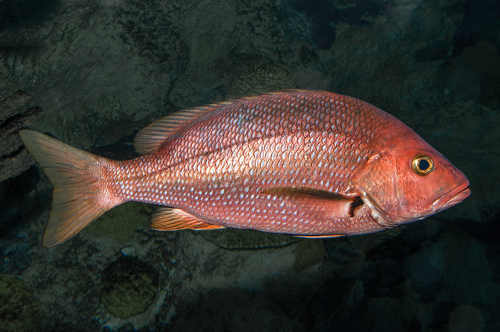
The northern red snapper's body is very similar in shape to other snappers, such as the mangrove snapper, mutton snapper, lane snapper, and dog snapper. All feature a sloped profile, medium-to-large scales, a spiny dorsal fin, and a laterally compressed body. Northern red snapper have short, sharp, needle-like teeth, but they lack the prominent upper canine teeth found on the mutton, dog, and mangrove snappers. They are rather large and are red in color.

This snapper reaches maturity at a length of about 39 cm (15 in). The common adult length is 60 cm (24 in), but may reach 100 cm (39 in). The maximum published weight is 50 lb, 4 oz (22.79 kg) and the oldest reported age is 57+ years.
Habitat

The northern red snapper is found at a depth of 30 to 620 feet in the Gulf of Mexico, the Caribbean Sea, and the southeastern Atlantic coast of Mexico and the United States and much less commonly northward as far as Massachusetts. In Latin American Spanish, it is known as mero, huachinango, pargo, or chillo.

This species commonly inhabits waters from 9–60 m (30–200 ft), but can be caught as deep as 90 m (300 ft) on occasion. They stay relatively close to the bottom, and inhabit rocky bottoms, ledges, ridges, and artificial reefs, including offshore oil rigs and shipwrecks. Like most other snappers, northern red snapper are gregarious and form large schools around wrecks and reefs. These schools are usually made up of fish of very similar size.

Reproduction

Diaz reported weight vs. length data for L. campechanus for the National Marine Fisheries Service (US). As northern red snapper grow longer, they increase in weight, but the relationship between length and weight is not linear. The relationship between total length (L, in inches) and total weight (W, in pounds) for nearly all species of fish can be expressed by an equation of the form:

Invariably, b is close to 3.0 for all species, and c is a constant that varies among species. Diaz reported that for red snapper, c=0.000010 and b=3.076. These values are for inputs of length in cm and result in weight in kg.

Part of

Where to see it

No dive sites list Northern Red Snapper yet. Explore the map to find sites near you.