
← All marine life
New Zealand Octopus
Species IUCN · Least Concern (LC)

New Zealand Octopus

Macroctopus maorum, (F. W. Hutton, 1880)

marine

About New Zealand Octopus

Macroctopus is a monospecific genus of cephalopod belonging to the family Octopodidae, the "typical octopuses". The only species in the genus is Macroctopus maorum, the Māori octopus or the New Zealand octopus (wheke in Māori). It is found in the waters around New Zealand and southern Australia. M. maorum is one of the largest octopus species living in the New Zealand and Australian waters. They feed mainly on crustaceans and fish. Although they have a short life span, the females lay thousands of eggs and are very protective of them. This taxon is regarded as a synonym of Pinnoctopus cordiformis by some authorities.

Appearance

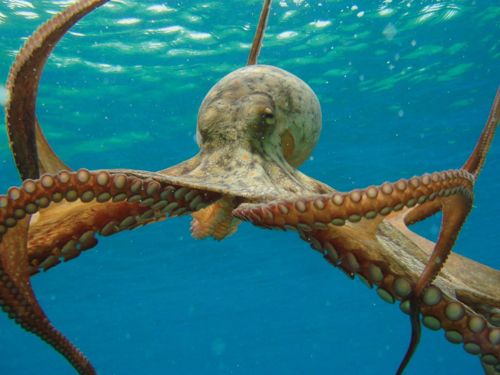
Macroctopus maorum is a large octopus and it is regularly described as a ‘robust’ species, it is a member of the Octopus macropus species complex. The morphological traits characteristic of this complex are a high number of gill lamellae, a robust conical copulatory organ and arms of varying length with long unequal dorsal arms generally four to six times longer than the mantle. Although being unequal, their arms are said to be long and evenly tapering and Macroctopus maorum are even known to regrow arms when one has been lost. Being the largest member of its complex arm span is said to exceed 3 metres (9.8 ft). They have four to six suckers on the first and second arm pairs which are usually about 40 millimetres (1.6 in) in size. Suckers are arranged in two rows down the arm length.
Habitat

M. maorum is commonly found in the waters of New Zealand and South Australia, preferring temperate to sub-antarctic waters. In New Zealand they are found off the coasts of both the North and South islands, and is one of the most common species of octopus in the country. M. maorum is also common in the waters of the islands surrounding New Zealand including Campbell, Chatham and Auckland Islands. In Southeast Tasmania, at Eaglehawk Bay the site of a commercial fishery is the only known inshore location where the M. maorum have been known to gather in large numbers year round.

Diet

A study of M. maorum off the coast of southeastern Tasmania found evidence of 12 different species in the stomachs of sampled octopuses with the dominant prey being the crab P. gaimardii and other M. maorum. This is a low number of prey species compared to other species of octopus and it is assumed that the diet of M. maorum in Southeastern Tasmania is more diverse than results indicated in the study. M. Maorum will eat bivalves, crustaceans and fish but are selective and show preference to lobster, crabs and scallops. As is the case with other octopus species, M. maorum injects prey with a toxin that slowly liquefies flesh so that it can be more easily digested. Cannibalism is a common behavior for many species of octopus in the order of large eating small, however small M. maorum are known to attack larger octopus particularly Octopus tetricus where habitats overlap. M.

Reproduction

During mating, the male Macroctopus maorum will be on top pinning down the female and usually overpowering the female physically or pouncing on them. The male will inserts a sperm packet by passing it along the arms to the oviduct of the female. When it gets near the oviduct, the end of the spermatophore burst open and release the sperm. Male octopus will then become senescent and die after mating. Female Macroctopus maorum mature and mate during March and October.

Part of

Where to see it

No dive sites list New Zealand Octopus yet. Explore the map to find sites near you.