
← All marine life
Neptune Grass
Species IUCN · Least Concern (LC)

Neptune Grass

Posidonia oceanica, (Linnaeus) Delile, 1813

marine

About Neptune Grass

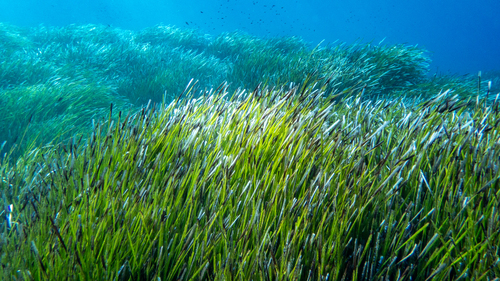
Posidonia oceanica, commonly known as Neptune grass or Mediterranean tapeweed, is a seagrass species that is endemic to the Mediterranean Sea. The mapping of submerged seagrass meadows in the Mediterranean has recently benefited from advanced artificial intelligence techniques. It forms large underwater meadows that are an important part of the ecosystem. The fruit is free floating and known in Italy as "the olive of the sea" (l'oliva di mare). Balls of fibrous material from its foliage, known as egagropili or Neptune balls, wash up to nearby shorelines.

Posidonia has a very high carbon absorption capacity, being able to soak up 15 times more carbon dioxide every year than a similarly sized area of the Amazon rainforest.

Appearance

Posidonia oceanica has roots (which mainly serve to anchor the plant to the substrate), rhizomes, and tapeform leaves.

The rhizomes, up to 1 centimetre (0.4 in) thick, grow both horizontally (plagiotropic rhizomes), and vertically (orthotropic rhizomes). The former, due to the presence at the bottom of lignited roots up to 15 centimetres (6 in) long, anchor the plant to the substrate. The latter, which increase height, have the function of combatting sanding due to continuous sedimentation. The two types of growth give rise to the so-called "kill", a terrace formation that consists of a network of strata of rhizomes, roots, and trapped sediments. In this way, posidonias colonise an environment that algae could hardly occupy due to the lack of roots.
Habitat

This species is found only in the Mediterranean Sea, where it is in decline, occupying an area of about 3% of the basin. This corresponds to a surface area of about 38,000 km2 (15,000 sq mi). Posidonia grows best in clean waters, and its presence is a marker for lack of pollution. Local depth distribution can also be influenced by wave exposure, with hydrodynamic conditions contributing to the position of the upper meadow limit. The presence of Posidonia can be detected by the masses of decomposing leaves on beaches. Such plant material has been used for composting, but Italian laws prohibit the use of marine algae and plants for this purpose.

Behaviour

=== Preventing the erosion of the Mediterranean Coast ===

Posidonia oceanica has similar characteristics to terrestrial plants, such as roots, rhizomatous stems, and cintiform leaves up to 1 m long arranged in clumps of six or seven. It flowers in autumn and produces floating fruits in spring, commonly known as sea olives.

It forms underwater meadows of considerable ecological importance. It constitutes the climax community of the Mediterranean Sea and plays an important role in protecting the coastline from erosion.The contribution of Posidonia oceanica seagrass meadows to sediment supply on the beaches of the Region of Murcia has been studied. Field measurements have shown that P. oceanica meadows can attenuate wave propagation, supporting their role in coastal protection. It is home to many animal and plant organisms that find food and protection in the meadows.

Reproduction

Posidonia oceanica reproduces both sexually and asexually (by stolons).

Part of

Where to see it

No dive sites list Neptune Grass yet. Explore the map to find sites near you.