
← All marine life
Neon Fusilier
Species IUCN · Least Concern (LC)

Neon Fusilier

Pterocaesio tile, (Cuvier, 1830)

marine

About Neon Fusilier

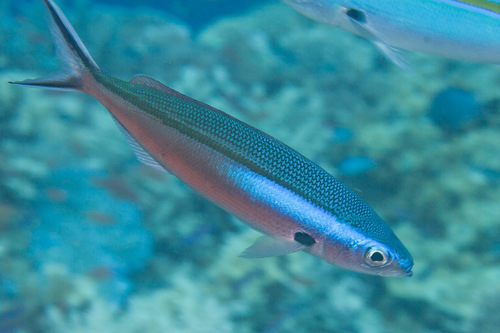
The dark-banded fusilier (Pterocaesio tile), also known as blue-streak fusilier, bluedash fusilier, or neon fusilier, is a species of marine ray-finned fish, a fusilier belonging to the family Caesionidae. It has a wide Indo-West Pacific range. It is of some importance to fisheries within its range.

Appearance

The dark banded fusilier has been recorded growing up to a total length of 30 cm (12 in), although a standard length of 21.2 cm (8.3 in) is more typical. It has a fusiform, elongated and compressed body. There are small conical teeth in the jaws and on the vomer and palatines. The dorsal fin contains 10–12 spines and 19–22 soft rays, while the anal fin has three spines and 13 soft rays. There are scales on both the dorsal and anal fins. There are 22–24 rays in the pectoral fins.

Habitat

The dark-banded fusilier is widespread in Indo-Pacific, from East Africa to the Tuamoto Islands, southern Japan, Mauritius, and the Austral Islands.

In Australian waters it occurs at the Rowley Shoals off Western Australia, Ashmore Reef in the Timor Sea and on the far northern Great Barrier Reef, as well as at reefs in the Coral Sea to the Solitary Islands in New South Wales and at Christmas Island and the Cocos (Keeling) Islands.

This species is a coral-reef associated species. It usually can be found in lagoon and on the reef flats at depths to 60 m (200 ft).

Humans & conservation

The dark-banded fusilier is heavily exploited in parts of its range, it is fished for using drive-in nets, gill nets, traps and blast fishing it is also caught to be used as bait by commercial tuna fisheries. Where it is sold for human consumption it can be sold as fresh fish or preserved as salt fish.

Part of

Where to see it

No dive sites list Neon Fusilier yet. Explore the map to find sites near you.