
← All marine life
Mimic Octopus
Species IUCN · Least Concern (LC)

Mimic Octopus

Thaumoctopus mimicus, M. Norman & Hochberg, 2005

marine

About Mimic Octopus

The mimic octopus (Thaumoctopus mimicus) is a species of octopus from the Indo-Pacific region. Like other octopuses, it uses its chromatophores to disguise itself. It is noteworthy for being able to impersonate a wide variety of other marine animals. While many animals mimic either their environment or other animals to avoid predation, the mimic octopus and its close relative the wunderpus are the only ones known to actively imitate several animals in order to elude predators.

Appearance

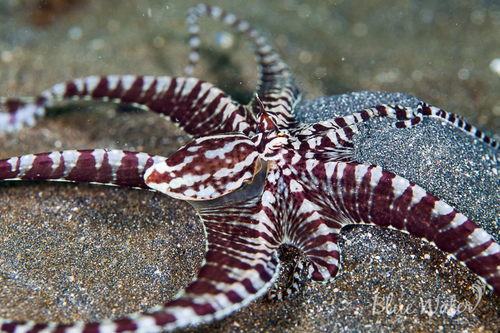
The mimic octopus is a smaller octopus, growing to a total length of about 60 cm (2 ft), including arms, with a diameter approximately that of a pencil at their widest. Small horns protrude from each eye. The octopus' natural color is light brown/beige, but it usually takes on a more noticeable hue of striped white and brown to scare off predators by imitating poisonous species. According to DNA sequence analysis, the second evolved trait was the simultaneous development of its lengthy arms and its flatfish-like swimming ability. By transfusing these traits together, the octopus transforms to a bold color pattern while swimming like a flatfish when hunting for food or resting.
Habitat

The mimic octopus was first discovered off the coast of Sulawesi, Indonesia in 1998 on the bottom of a muddy river mouth. It has since been found to inhabit the Indo-Pacific, ranging from the Red Sea and Gulf of Oman in the west to New Caledonia in the east, and Gulf of Thailand and the Philippines in the north to the Great Barrier Reef in south. Most documented observations are from Indonesia. It is primarily found in areas with sand or silt at depths of less than 15 m (49 ft).

Diet

The mimic octopus can be described as either a hunter or a forager. It is believed to be a hunter because scientists have observed and recorded the octopus having the ability to stalk prey and hunt down small fish and catch them. More often, however, the mimic octopus can be seen foraging for food. It does this by using a jet of water through its siphon to glide over the sand while searching for prey, and using its slender arms to reach into crevices in coral, as well as holes in the sand, and use its suction cups to grab small crustaceans and eat them. Because the mimic octopus prefers to live in shallow, murky waters, it is believed that its diet consists almost exclusively of small fish and crustaceans. They are believed to be carnivores, and are not known to eat any type of plant or vegetation.

Behaviour

The mimic octopus uses a jet of water through its funnel to glide over the sand while searching for prey, which mostly consists of small fish, crabs, and worms. It prefers river mouths and estuaries, as opposed to reefs which are usually preferred as shelter by other types of octopus.

Part of

Where to see it

No dive sites list Mimic Octopus yet. Explore the map to find sites near you.