
← All marine life
Milkfish
Species IUCN · Least Concern (LC)

Milkfish

Chanos chanos, (Fabricius, 1775)

marinebrackishfreshwater

About Milkfish

The milkfish (Chanos chanos) is a widespread species of ray-finned fish found throughout the Indo-Pacific. It is the sole living species in the family Chanidae, and the only living member of the genus Chanos.

The repeating scientific name (tautonym) is from Greek khanos (χάνος 'mouth'). They are grouped in the order Gonorhynchiformes and are most closely related to the Ostariophysi—freshwater fishes such as carps, catfish, and loaches.

The species has many common names. The Hawaiian name for the fish is awa, and in Tahitian it is ava. It is called bangús (Tagalog: [bɐˈŋus]) in the Philippines, where it is popularly known as the national fish, although the National Commission for Culture and the Arts has stated that this is not the case as it has no basis in Philippine law. In the Nauruan language, it is referred to as ibiya. Milkfish is also called bandeng or bolu in Indonesia.

Appearance

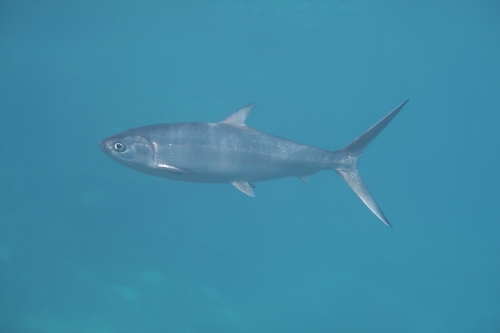
The milkfish can grow to 1.80 m (5 ft 11 in), but are most often no more than 1 m (39 in) in length. They can reach a weight of about 19 kg (42 lb) in pond. and an age of 15 years. They have an elongated and almost compressed body, with a generally symmetrical and streamlined appearance, one dorsal fin, falcate pectoral fins and a sizable forked caudal fin. The head is small relative to the body. The mouth is small and toothless. The body is olive green, with silvery flanks and dark bordered fins. They have 13–17 dorsal soft rays, 8–10 anal soft rays and 31 caudal fin rays. There are numerous fine intramuscular bones, which may complicate human consumption of the fish (see "Consumption" below).

Habitat

Chanos chanos occurs in the Indian Ocean and across the Pacific Ocean, from South Africa to Hawaii and the Marquesas, from California to the Galapagos, north to Japan, south to Australia. A single specimen was reported in 2012 in the eastern Mediterranean Sea. In 1877, the California Fish and Game Commission introduced 100 milkfish from Hawaii to the inland waters of Solano County, California. The introduced population could not establish itself permanently and it is currently unknown how their presence affected the native ecosystem.

Milkfishes commonly live in tropical offshore marine waters around islands and along continental shelves, at depths of 1 to 30 m (3 ft 3 in to 98 ft 5 in). They also frequently enter estuaries and rivers.

Diet

Milkfish are omnivorous opportunistic feeders. Juvenile milkfish eat a variety of foods including phytoplankton, zooplankton, filamentous green algae, and small invertebrates. Similarly to juveniles, adults also eat benthic invertebrates and additionally planktonic and nektonic items such as clupeid juveniles.

Behaviour

Reproduction of milkfish in nature is far less understood than populations of milkfish bred and propagated in captivity (see "Aquaculture" below). In the wild, milkfish take 3–5 years to mature. Females can produce 0.5–6 million eggs and have the ability to spawn more than once a year. Spawning takes place at night, may be lunar periodic, and is strongly seasonal. Milkfish eggs are pelagic and range between 1.1 and 1.25 mm (0.043 and 0.049 in) in diameter. Spawning sites are clear, warm, shallow waters above sand or coral reefs. It is believed milkfish prefer these locations to minimize predation from benthic planktivores.

Humans & conservation

According to the International Union for Conservation of Nature, as of 2019, milkfish were not a threatened species. However, little information is available on wild stocks.

Where to see it

No dive sites list Milkfish yet. Explore the map to find sites near you.