
← All marine life
Milk Shark
Species IUCN · Vulnerable (VU)

Milk Shark

Rhizoprionodon acutus, (Rüppell, 1837)

marinebrackishfreshwater

About Milk Shark

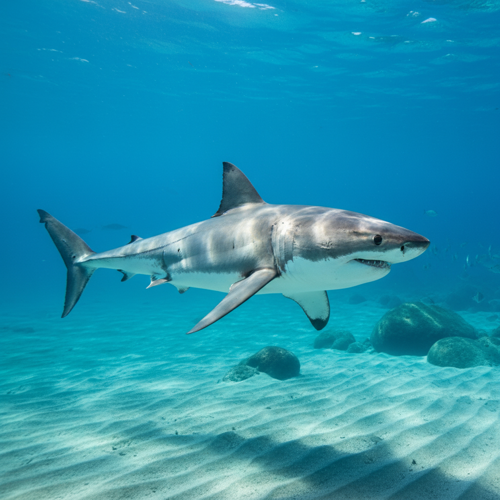
The milk shark (Rhizoprionodon acutus) is a species of requiem shark, and part of the family Carcharhinidae, whose common name comes from an old Indian belief that consumption of its meat promotes lactation. The largest and most widely distributed member of its genus, the milk shark typically measures 1.1 m (3.6 ft) long, and can be found in coastal tropical waters throughout the eastern Atlantic and the Indo-Pacific regions. Occurring from the surface to a depth of 200 m (660 ft), this species is common near beaches and in estuaries, and has been recorded swimming up rivers in Cambodia. Juveniles are known to inhabit tidal pools and seagrass meadows. The milk shark has a slender body with a long, pointed snout and large eyes, and is a nondescript gray above and white below. This shark can be distinguished from similar species in its range by the long furrows at the corners of its mouth, and seven to 15 enlarged pores just above them.

Appearance

The largest member of its genus, off West Africa the milk shark has been reported to reach 1.78 m (5.8 ft) and 22 kg (49 lb) for males, and 1.65 m (5.4 ft) and 17 kg (37 lb) for females, though there is uncertainty regarding the species identity of these specimens. Even if accepted, these figures are considered exceptional and most individuals do not exceed 1.1 m (3.6 ft) in length. Generally, females are heavier and attain a greater maximum size than males.
Habitat

The milk shark has the widest distribution of any Rhizoprionodon species. In the eastern Atlantic Ocean, it is found from Mauritania to Angola, as well as around Madeira. Since 1985, there have been four occurrences, temporally and spatially distinct, of the milk shark in the central Mediterranean Sea, with a likely entry via the Strait of Gibraltar. In the Indian Ocean, it occurs from South Africa and Madagascar northward to the Arabian Peninsula, and eastward to South and Southeast Asia. In the Pacific Ocean, this species occurs from China and southern Japan, through the Philippines and Indonesia, to New Guinea and northern Australia. The milk shark likely once had a contiguous distribution by way of the Tethys Sea, until during the Miocene epoch, when eastern Atlantic sharks were isolated from Indo-Pacific sharks by the collision of Asia and Africa.

Behaviour

One of the most (if not the most) abundant near-shore sharks within its range, the milk shark feeds mainly on small benthic and bony fishes. Occasionally squid, octopus, cuttlefish, crabs, shrimp, and gastropods are also taken. In Shark Bay, the most important prey are silversides, herring, smelt-whitings, and wrasses; this is also the only local shark species that preys on the Waigeo seaperch (Psammoperca waigiensis), found in seagrass beds avoided by other sharks. In the Gulf of Carpentaria, it feeds mainly on halfbeaks, herring, and mullets, and is also a major predator of penaeid prawns. Smaller sharks eat proportionately more cephalopods and crustaceans, switching to fish as they grow older.

Humans & conservation

The milk shark is harmless to humans because of its small size and teeth. Caught using longlines, gillnets, trawls, and hook-and-line, this shark is marketed fresh or dried and salted for human consumption, and is also used for shark fin soup and fishmeal. Its abundance makes it a significant component of artisanal and commercial fisheries across its range. Off northern Australia, it ranks among the most common sharks caught in trawls, and comprises 2% and 6% of the annual gillnet and longline catches, respectively. This species is also one of the most commercially important sharks caught off Senegal, Mauritania, Oman, and India. Some sport fishers regard it as a game fish.

Part of

Where to see it

No dive sites list Milk Shark yet. Explore the map to find sites near you.