
← All marine life
Military Barracuda
Species IUCN · Least Concern (LC)

Military Barracuda

Sphyraena putnamae, Jordan & Seale, 1905

marine

About Military Barracuda

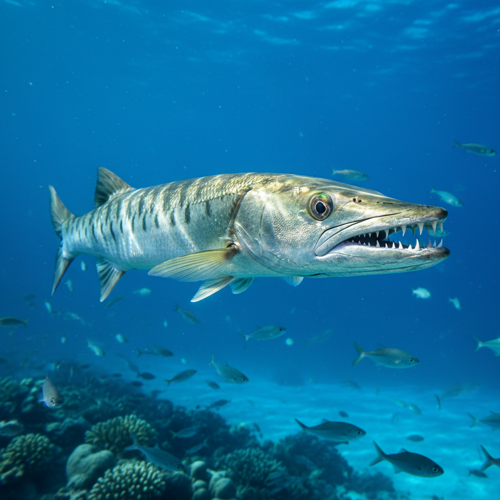
Sphyraena putnamae, the sawtooth, chevron or military barracuda, is a species of barracuda found in all tropical seas and temperate waters of major oceans with the exception of the Eastern Pacific. It is found near shores in bays, turbid lagoons, and some reefs. It can be distinguished by the many (about 15) dark chevron-shaped markings along its side, and its forked caudal fin. It spends its time in the shallow part of the sea off the coast, and stays closer to the surface levels of the open ocean. It can live up to 14 years, reaching lengths of six feet (1.8 m) long and weighing over 100 pounds (45 kg).

Habitat

Sphyraena putnamae are most frequently observed in the Indo-Pacific region, consisting of the Indian Ocean and the western Pacific Ocean. The heaviest concentrations of the species have been found off the southeastern coast of Africa, north coast of Australia, and in the waters between east and southeast Asia. The center of diversity is likely to be found in the eastern Indian Ocean or western Pacific regions, as this is where the species was first discovered and has maintained its highest population densities. On a few occasions, Sphyraena putnamae has been sighted in other locations, such as the coast of Florida and in various locations near Central America. Sphyraena putnamae share the same habitats as many other species of Sphyraena. They normally inhabit reefs, bays, and lagoons off the coast.
Diet

Sphyraena putnamae consume diverse prey items, which can be grouped into three main categories: teleosts, molluscs, and crustaceans. Teleosts are the preferred food source and dominant food component for Sphyraena putnamae, while mollusks and crustaceans constitute the secondary and accessory food items respectively. The main constituents of their teleost diet included caragids, scombrids, engraulids, leiognathids, and synodontids. Sphyraena putnamae is mostly a nocturnal predator that individually searches for prey at night, and moves in groups throughout the day. Sphyraena putnamae also have a preference for near-shore waters, turbid lagoons, bays, and reefs. In the dominant food category, it is composed mainly of the species Decapterus Russelli, Megalaspis Cordyla, and Rastrelliger Kanagurta. This group of teleosts constitutes over 85% of the diet of Sphyraena putnamae.

Behaviour

Sphyraena putnamae is active at night, but also forms large schools during the day. Adults of the species are solitary, while juveniles are gregarious and form schools.

Reproduction

Young barracuda drift inshore in spring, and move to deeper water in the late fall. Spawning season is from April until October off southern Florida. Most Males mature at two years of age, and most females mature at three years of age. In Sphyraena putnamae, the sex ratio observed of females:males was 1.49:1 respectively. At the age of sexual maturity, fork length, which is the measurement from the tip of the snout to the fork of the tail, was measured to be 41.33 cm for females and 40.68 cm for males. This species exhibits high fecundity, and hence a high reproductive potential, and spawn throughout the entire year. There are two main peaks of reproduction in the months of April–May being the first peak and the second peak in November through January. The smallest mature females were recorded to be 24.9 cm and the smallest mature males to be 24.5 cm.

Part of

Where to see it

No dive sites list Military Barracuda yet. Explore the map to find sites near you.