
← All marine life
Mediterranean Slipper Lobster
Species IUCN · Data Deficient (DD)

Mediterranean Slipper Lobster

Scyllarides latus, (Latreille, 1803)

marine

About Mediterranean Slipper Lobster

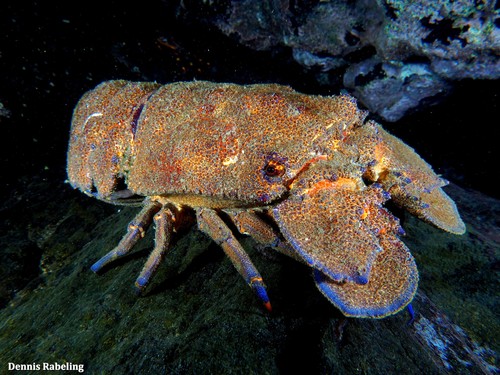
Scyllarides latus, the Mediterranean slipper lobster, is a species of slipper lobster found in the Mediterranean Sea and in the eastern Atlantic Ocean. It is edible and highly regarded as food, but is now rare over much of its range due to overfishing. Adults may grow to 1 foot (30 cm) long, are camouflaged, and have no claws. They are nocturnal, emerging from caves and other shelters during the night to feed on molluscs. As well as being eaten by humans, S. latus is also preyed upon by a variety of bony fish. Its closest relative is S. herklotsii, which occurs off the Atlantic coast of West Africa; other species of Scyllarides occur in the western Atlantic Ocean and the Indo-Pacific. The larvae and young animals are largely unknown.

Appearance

S. latus can grow to a total body length about 45 centimetres (18 in), although rarely more than 30 cm (12 in). This is equivalent to a carapace length of up to 12 cm (4.7 in). An individual may weigh as much as 1.5 kilograms (3.3 lb). As in all slipper lobsters, the second pair of antennae are enlarged and flattened into "shovels" or "flippers". Despite the name "lobster", slipper lobsters such as Scyllarides latus have no claws, and nor do they have the protective spines of spiny lobsters. Instead, the exoskeleton, and particularly the carapace, are thicker than in clawed lobsters and spiny lobsters, acting as resilient armour. Adults are cryptically coloured, and the carapace is covered in conspicuous, high tubercles.
Habitat

Scyllarus latus is found along most of the coast of the Mediterranean Sea (one exception being the northern Adriatic Sea), and in parts of the eastern Atlantic Ocean from near Lisbon in Portugal south to Senegal, including the islands of Madeira, the Azores, the Selvagens Islands and the Cape Verde Islands. In Senegal, it occurs together with a related species Scyllarides herklotsii, which it closely resembles.

Diet

The diet of S. latus consists generally of molluscs. The preferred prey is, according to different sources, either limpets or bivalves. The prey, which S. latus can detect even under 3.5 cm (1.4 in) of sediment, is opened by careful use of the strong pointed pereiopods. They will also eat oysters and squid, but not sea urchins or muricid snails. They eat more in warmer seasons, getting through 3.2 oysters per day in July, but only 0.2 oysters per day in January.

Behaviour

S. latus lives on rocky or sandy substrates at depths of 4–100 metres (13–328 ft). They shelter during the day in natural dens, on the ceilings of caves, or in reefs, preferring situations with more than one entrance or exit.

Reproduction

Male Scyllarus latus carry spermatophores at the base of the last two pairs of pereiopods in April. Fertilisation has not been observed in this species, but most reptant decapods mate with the ventral surfaces together. Between July and August, females carry around 100,000 eggs on their enlarged, feathery pleopods. The eggs develop from being a bright orange colour to a dark brown before being shed into the water after around 16 days of development. There is normally only one generation per year.

Humans & conservation

S. latus is edible, but it is a relatively rare species, and is therefore of little interest to fisheries. However, it is caught in small numbers throughout its distribution, mostly in trammel nets, by trawling and in lobster pots. An annual catch of 2,000–3,000 kg (4,400–6,600 lb) has been reported for Israel. Catching by hand has become increasingly frequent, since the advent of SCUBA diving made the animal's habitat more accessible to humans. This may have affected population sizes of S. latus in some areas.

Part of

Where to see it

No dive sites list Mediterranean Slipper Lobster yet. Explore the map to find sites near you.