
← All marine life
Marine Iguana
Species IUCN · Vulnerable (VU)

Marine Iguana

Amblyrhynchus cristatus, Bell, 1825

marine

About Marine Iguana

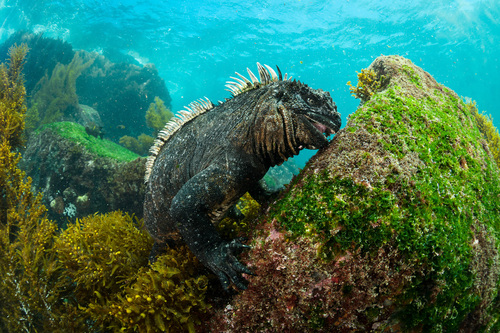
The marine iguana (Amblyrhynchus cristatus), also known as the sea iguana, saltwater iguana, or Galápagos marine iguana, is a species of iguana found only on the Galápagos Islands (Ecuador). Unique among modern lizards, it is a marine reptile that has the ability to forage in the sea for algae, which make up almost all of its diet. Marine iguanas are the only extant lizard that spends time in a marine environment. Large males are able to dive to find this food source, while females and smaller males feed during low tide in the intertidal zone. They mainly live in colonies on rocky shores where they bask after visiting the relatively cold water or intertidal zone, but can also be seen in marshes, mangrove swamps and beaches. Large males defend territories for a short period, but smaller males have other breeding strategies. After mating, the female digs a nest hole in the soil where she lays her eggs, leaving them to hatch on their own a few months later.

Marine iguanas vary in appearance between the different islands and several subspecies are recognized. Although relatively large numbers remain and it is locally abundant, this protected species is considered threatened, primarily from El Niño cycles, introduced predators and chance events like oil spills.

Appearance

Early visitors to the Galápagos Islands considered the marine iguanas ugly and disgusting. In 1798, captain James Colnett of the British Royal Navy wrote:

The [i]guanas are small, and of a sooty black, which, if possible, heightens their native ugliness. Indeed, so disgusting is their appearance, that no one on board could be prevailed on, to take them as food.

On his visit to the islands in 1835, despite making extensive observations on the creatures, Charles Darwin was revolted by the animals' appearance, writing:

The black Lava rocks on the beach are frequented by large (2–3 ft [0.6–0.9 m]), most disgusting, clumsy Lizards. They are as black as the porous rocks over which they crawl & seek their prey from the Sea. Somebody calls them 'imps of darkness'. They assuredly well-become the land they inhabit.

Diet

The marine iguana forages almost exclusively on red and green algae in the inter- and subtidal zones. At least 10 genera of algae are regularly consumed, including the red algae Centroceras, Gelidium, Grateloupia, Hypnea, Polysiphonia and Pterocladiella. In some populations, the green algae Ulva dominates the diet. The algal diet varies depending on algal abundance, individual preferences, foraging behaviour, season and exact island of feeding. Some species with chemical deterrents, such as Bifurcaria, Laurencia and Ochtodes, are actively avoided, but otherwise algal food choice mainly depends on energy content and digestibility. On Santa Cruz Island, 4–5 red algal species are the food of choice. During neap low tides, however, the usually avoided green algae Ulva lobata is eaten more often since the preferred red algae is not easily available.

Behaviour

Female marine iguanas reach sexual maturity at the age of 3–5 years, while males reach sexual maturity at the age of 6–8 years. Sexual maturity is marked by the first steep and abrupt decline in bone growth cycle thickness. Marine iguanas can reach an age of up to 60 years, but average lifespan is 12 years or less.

Reproduction in the marine iguana begins during the last part of the cold and dry season, with breeding from December to March and nesting from January to April. The exact timing varies with location, depending on algal growth and the nutrient-rich Cromwell Current. It occurs earliest on islands like Fernandina, Isabela, Santa Fé and Genovesa, and latest on islands like Española. An adult marine iguana, whether male or female, will typically breed every other year, but if there is plenty of food a female may breed each year.

Humans & conservation

The marine iguana has a relatively small range and is currently considered vulnerable by the IUCN. Most subpopulations have the same IUCN rating, but those of San Cristóbal, Santiago and Genovesa Islands are considered endangered.

Where to see it

No dive sites list Marine Iguana yet. Explore the map to find sites near you.