
← All marine life
Mangrove Red Snapper
Species IUCN · Least Concern (LC)

Mangrove Red Snapper

Lutjanus argentimaculatus, (Forsskål, 1775)

marinebrackishfreshwater

About Mangrove Red Snapper

The mangrove red snapper (Lutjanus argentimaculatus), also known as mangrove jack, grey snapper, creek red bream, Stuart evader, dog bream, purple sea perch, red bream, red perch, red reef bream, river roman, or rock barramundi (though it is not closely related to bream, jack, or barramundi), is a species of marine ray-finned fish, a snapper belonging to the family Lutjanidae. It has a wide Indo-Pacific range and has recently been recorded in the eastern Mediterranean Sea.

Appearance

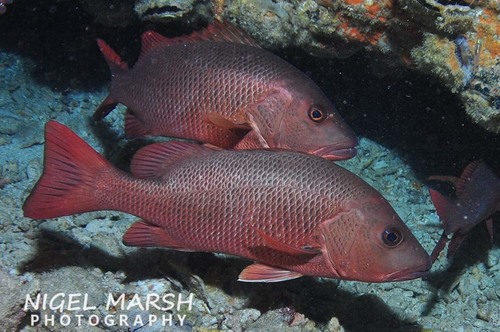
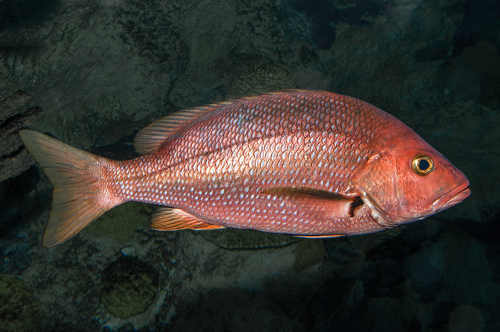
Coloration of the mangrove red snapper ranges from burnt orange, to copper, to bronze and dark reddish-brown, depending on its age and environment. Younger fish caught in estuarine areas are often darker than older fish taken from offshore reef areas, and exhibit lighter vertical bands down their flanks. The maximum recorded length is 150 centimetres (4.9 ft), but 80 centimetres (2.6 ft) is most common.

Like other tropical snappers (family Lutjanidae), mangrove jacks have prominent fangs in their jaws that are used for seizing and holding prey, akin to the canine teeth of a mammal. These teeth can cause a nasty injury to unwary fishers.
Habitat

The mangrove red snapper is native to the Indian Ocean and the western Pacific Ocean from the African coast to Samoa and the Line Islands and from the Ryukyus in the north to Australia in the south. It has also rarely been recorded in the Mediterranean Sea, having undergone Lessepsian migration from the Red Sea since at least 1979.

As its name implies, the mangrove red snapper is commonly found in mangrove-lined estuarine systems, however some make their way into complete freshwater systems, particularly at a juvenile age. They migrate to offshore reefs to spawn. As they mature, mangrove red snappers move into open waters, sometimes hundreds of kilometers from the coast to breed. These larger fish are sometimes caught by bottom-fishers with heavy tackle, though they remain difficult to land due to their speed and proximity to sharp reef bottoms.

Reproduction

Like many marine fish, the mangrove red snapper is a broadcast spawner. Spawning occurs during the austral spring-summer seasons in Northeastern Queensland, "[beginning] around October, peaked in December and then declined over summer from January through March."[sic]; conversely, it occurs during boreal autumn in Thailand from late September to November. Both of these periods coincide with high rainfall and decreasing water temperature, which may result in nutrients being flushed into inshore waters from alluvial runoff. Due to the continuing presence of juveniles in March and April, Thai mangrove jacks may continue spawning during the boreal springtime. Mangrove jacks in Palau were observed to form spawning aggregations in reef lagoons and outer reef slopes.

Humans & conservation

Mangrove red snapper is a popular and important commercial and recreational fish throughout its range, and considered to be an excellent food fish, which allows it to command a relatively high market price.

For fishermen, the telltale sign of a hooked mangrove red snapper is the explosive run for cover once the bait (or lure) is taken. Many fish (and so lures) are lost once they reach the protection of the snags as a result of their initial burst of speed.

In Southeast Asia, these fish are aquacultured; the fry are collected from the wild, and reared to market size in brackish-water floating net cages and ponds. During the turn of the new millennium, efforts were made to improve production of aquacultured mangrove jacks, and the reproductive mechanisms of the fish were discovered, along with effective methods for induced spawning through hormonal injection.

Part of

Where to see it

No dive sites list Mangrove Red Snapper yet. Explore the map to find sites near you.