
← All marine life
Mahi-Mahi
Species IUCN · Least Concern (LC)

Mahi-Mahi

Coryphaena hippurus, Linnaeus, 1758

marinebrackish

About Mahi-Mahi

The mahi-mahi ( MAH-hee-MAH-hee), common dolphinfish, dolphinfish, dolphin or dorado (Coryphaena hippurus) is a surface-dwelling ray-finned fish found in off-shore temperate, tropical, and subtropical waters worldwide. It is one of two members of the family Coryphaenidae, the other being the pompano dolphinfish. These fish are most commonly found in the waters around the Gulf of Mexico, Costa Rica, Hawaii, and the Indian Ocean. In Italy it is called corifena, lampuga or pesce capone, and has even given its name to the caponata though eggplant has now taken the place of the fish.

Appearance

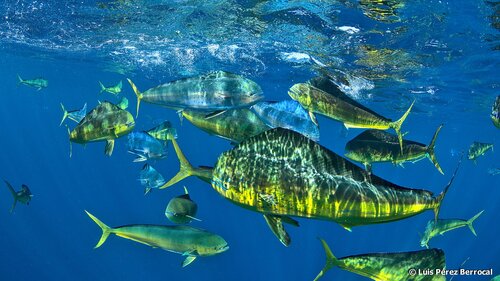
Mahi-mahi have compressed bodies and one very long dorsal fin extending from the head almost to the tail fin. Mature males have distinctive "foreheads"; it grows as the fish matures and often protrudes well above the body proper, which is streamlined by the musculature of the back. This "hump" is a sexually dimorphic feature; females have a rounded head. Their caudal fins and anal fins are sharply concave. They are distinguished by dazzling colors – golden on the sides, and bright blues and greens on the sides and back. The pectoral fins of the mahi-mahi are iridescent blue. The flank is broad and golden.

Out of the water, the fish often change color (giving rise to their Spanish name, dorado, 'golden'), going through several hues before finally fading to a muted yellow-grey upon death.

Diet

Mahi-mahi are carnivorous, feeding on small, pelagic bony fish (such as flying fish, man-o-war fish, sargassum fish, and triggerfish), pelagic larvae of benthic bony fish (such as flying gurnards, triggerfish, pufferfish, and grunts), crabs, other crustaceans, squid, other epipelagic cephalopods, scyphozoans, and juveniles of large, teleost forage fish such as tuna, billfish, jack, mackerel, and other mahi-mahi. They have also been known to eat zooplankton. To pursue such varied pelagic prey, mahi-mahi are fast swimmers, swimming as fast as 50 knots (92.6 km/h; 57.5 mph).

Reproduction

Males and females are sexually mature in their first year, usually by the age of 4–5 months. Spawning can occur at body lengths of 20 cm (7.9 in). Females may spawn two to three times per year, and produce between 80,000 and 1,000,000 eggs per event. In waters at 28 °C (82 °F), mahi-mahi larvae are found year-round, with greater numbers detected in spring and fall.

Mahi-mahi fish are mostly found in the surface water. Their flesh is grey-white when raw, cooking to an attractive white with a clean, non-fishy flavour.

Part of

Where to see it

No dive sites list Mahi-Mahi yet. Explore the map to find sites near you.