
← All marine life
Lumpsucker
Group

Lumpsucker

Cyclopteridae, Bonaparte, 1831

marine

About Lumpsucker

The Cyclopteridae are a family of marine fishes, commonly known as lumpsuckers or lumpfish, in the order Scorpaeniformes. They are found in the cold waters of the Arctic, North Atlantic, and North Pacific oceans. The greatest number of species are found in the North Pacific. The family name Cyclopteridae derives from the Greek words κύκλος (kyklos), meaning "circle" and πτέρυξ (pteryx), meaning "wing" or "fin" in reference to the circle-shaped pectoral fins of most of the fish in this family.

Appearance

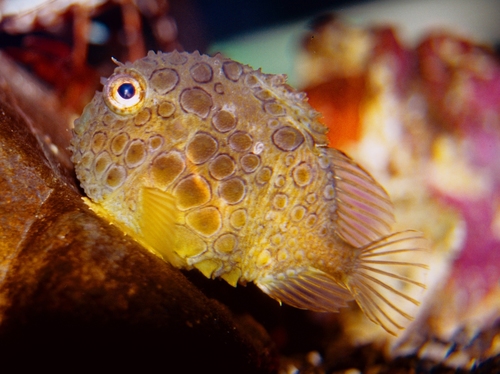
Lumpsuckers are named appropriately enough; their portly bodies are nearly spherical with generally drab coloration and lithic patterns. The "sucker" part refers to the fish's modified pelvic fins, which have evolved into adhesive discs (located ventrally, behind the pectoral fins); the fish use these discs to adhere to the substrate. Many species have bony, wart-like tubercles adorning the head and body; these are important taxonomic features of the family.
Habitat

As their appearance might suggest, lumpsuckers are poor swimmers. Most species are benthic; that is, they spend most of their time on or near the bottom. The fish are found on rocky or muddy substrates, where their colouration allows for effective camouflage. Members of the family are found primarily on the continental shelf or slope, at depths down to 1,700 m (5,600 ft). Some of the deeper-living species are, however, pelagic remaining some distance above the ocean floor.

Benthic species feed on sessile invertebrates such as polychaete worms, crustaceans and mollusks. Pelagic species target prey they are capable of overtaking, namely slow-moving jellyfish and ctenophores.

Behaviour

Lumpsuckers are a poorly studied group, with little known of their behaviour and biology. At least some species are known to travel great distances in order to spawn in shallow, intertidal waters (from December to June in the smooth lumpsucker); this may well be true of all species. Males are also known to guard the brood of spherical eggs.

One of the peculiarities of lumpsuckers' neural systems is that they lack Mauthner cell neurons in their hindbrain, while these cells are present in virtually all other teleost fish. Nevertheless, lumpsuckers do have a C-startle response, which is apparently mediated by other hindbrain cells.

Hatchlings have well-developed pectoral fins and adhesive pelvic discs, which the fish use to cling to rocks in shallow water. Young fish remain in shallow, warmer water until fully developed. Pacific cod and sablefish are known predators of lumpsuckers.

Humans & conservation

The only species that is targeted commercially is Cyclopterus lumpus, which is targeted primarily for its roe in Canada, Greenland, Iceland, and Norway, and to a lesser extent in Denmark and Sweden. Cyclopterus lumpus are also caught from the wild to provide broodstock for the aquaculture industry, where the fish is used as a cleaner fish to remove sea lice in salmon aquaculture.

Species in this group

Where to see it

No dive sites list Lumpsucker yet. Explore the map to find sites near you.