
← All marine life
Lumpfish
Species

Lumpfish

Cyclopterus lumpus, Linnaeus, 1758

marine

About Lumpfish

Cyclopterus is a genus of marine ray-finned fish belonging to the family Cyclopteridae, the lumpsuckers or lumpfish. Its only species is Cyclopterus lumpus, the lumpsucker or lumpfish. It is found in the North Atlantic and adjacent parts of the Arctic Ocean, ranging as far south as the Chesapeake Bay (rare south of New Jersey) on the North American coast and Spain (rare south of the English Channel) on the European coast. The species has been reported twice in the Mediterranean Sea, off Croatia in 2004 and Cyprus in 2017.

Appearance

Cyclopterus is sexually dimorphic with females reaching larger sizes than the males. Males typically reach 30–40 cm (12–16 in) in length while females can typically grow up to 50 cm (20 in) in length and 5 kg (11 lb 0 oz) in weight. The largest specimen recorded measured 61 cm (24 in) in length, and 9.6 kg (21 lb 3 oz) in weight. In the brackish water of the Baltic Sea, it usually does not surpass 20 cm (8 in).

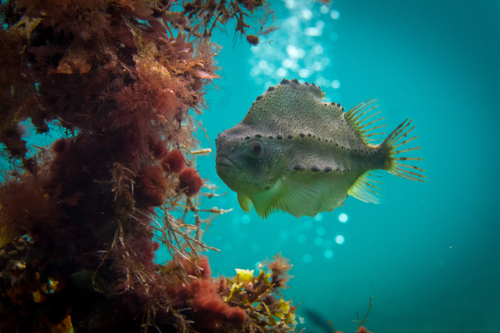
The body is ball-like. It has a knobbly, ridged back and three large bony tubercles on each flank. Its pelvic fins form suction discs which it uses to attach strongly to rocks or other surfaces. The head and the pectoral fins of males are larger than those of females. It has a jelly-like layer of fat under the skin. Its colour is highly variable; bluish, greyish, olive, yellowish or brownish. Mature males turn orange-reddish during the breeding season.

Reproduction

Cyclopterus spend the first few months following hatching in tidal pools, or in association with floating seaweed clumps. As they grow they migrate out into open water far from land where they live in the pelagic zone feeding upon gelatinous zooplankton, fish eggs and small crustaceans. When they reach maturity they will migrate to coastal areas in spring to breed. During the breeding season, males change colour, taking on a reddish/orange colouration. The population spawns over many months with spawning fish being caught in Iceland from March until August. Females which have spawned during the previous year tend to return to the same area when spawning again. They will also return at a similar time of year i.e. individuals which spawned early and late in the season will return to spawn early and late in the season the following year.

Humans & conservation

Cyclopterus is fished for its roe, landings of lumpfish roe varied from approximately 2,000–8,000 metric tons (2,200–8,800 short tons) from 1977 to 2018. In recent years, Iceland and Greenland have been the two largest fishing nations in regards to lumpfish and account for >95% of the global catch. Historically, Norway and Canada also contributed significant amounts but due to a decrease in the price of salted roe, and a severe population decline in Canada, the contribution from these countries has decreased. Denmark and Sweden have also contributed but the amount has been low in comparison with the other countries. Female fish are the main target for the fishery which utilizes the roe to make lumpfish caviar. Lumpfish are targeted close to the shore, where they come to spawn, using small fishing boats (generally less than 15 m or 49 ft) with large mesh gillnets.

Where to see it

No dive sites list Lumpfish yet. Explore the map to find sites near you.