
← All marine life
Longnose Trevally
Species IUCN · Least Concern (LC)

Longnose Trevally

Carangoides chrysophrys, (Cuvier, 1833)

marinebrackish

About Longnose Trevally

The longnose trevally (Carangoides chrysophrys), also known as the tea-leaf trevally, club-nosed trevally, grunting trevally or dusky trevally, is a species of inshore marine fish in the jack family, Carangidae. The species is distributed throughout the tropical and subtropical waters of the Indian and west Pacific Oceans from South Africa to New Zealand and Japan, inhabiting coastal waters, especially reefs, to a depth of 90 m. The longnose trevally is distinguished from similar species by a combination of a scaleless breast and the number of gill rakers and fin rays. It is a moderately large fish, growing to a maximum known length of 72 cm and 4.35 kg. The longnose trevally is a predatory fish, consuming small fish, crustaceans and molluscs. The species is of minor commercial importance throughout its range, and is considered to be a good table fish.

Appearance

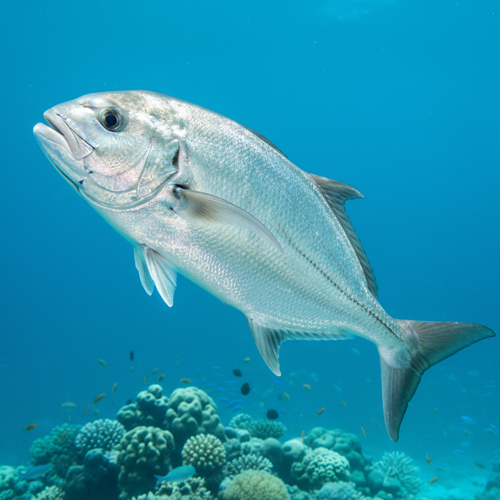
The longnose trevally is similar to other jacks in its overall body profile, having a strongly compressed, ovate shape as a juvenile, gradually becoming more oblong with age. It is a moderately large fish, recorded up to 72 cm in length and 4.35 kg in weight. The dorsal profile is more convex than the ventral profile. One of the species major diagnostic characters is its snout shape, having a gently sloped dorsal profile from the nape to near the snout, but becoming abruptly vertical just before the mouth cleft. Both of the jaws contain anteriorly widening bands of small villiform teeth, with larger individuals also having a number of conical outer teeth. There are two separate dorsal fins, the first consisting of 8 spines and the second of 1 spine and 18 to 20 soft rays. The anal fin comprises two detached anterior spines, followed by 1 spine and 14 to 17 soft rays.
Habitat

The longnose trevally inhabits tropical to subtropical waters in the Indian and west Pacific Oceans, ranging from South Africa and Madagascar, north to the Red Sea and Persian Gulf, east to India, South East Asia, Indonesia, Japan and to Fiji. The longnose trevally has been reported from many west Pacific islands, indicating that it is widespread in this region. The species ranges as far north as the Okinawa, Japan and as far south as northern Australia and New Zealand.

Humans & conservation

The longnose trevally is an epibenthic predator, taking prey from the seafloor or just above it, with only one study ever to thoroughly record its diet, which was carried out in the Gulf of Carpentaria of Australia. Here it was found its main prey were small fish, with considerable quantities of molluscs, brachyurans, and other crustaceans also taken. In South Africa, the species is thought to prefer prawns as its major dietary component, with crabs and small fish also taken. The longnose trevally has a fairly soft mouth, which may partly determine its diet. Very little is known of reproduction in the species, although juveniles have been recorded from shallow coastal bays.

Part of

Where to see it

No dive sites list Longnose Trevally yet. Explore the map to find sites near you.