
← All marine life
Longhorn Sculpin
Species

Longhorn Sculpin

Myoxocephalus octodecemspinosus, (Mitchill, 1814)

marinebrackish

About Longhorn Sculpin

The longhorn sculpin (Myoxocephalus octodecemspinosus) is a species of marine ray-finned fish belonging to the family Cottidae, the typical sculpins.This species is found in the Northwest Atlantic Ocean. It is a predatory and scavenging fish that can feed on the remains of other organisms.

Appearance

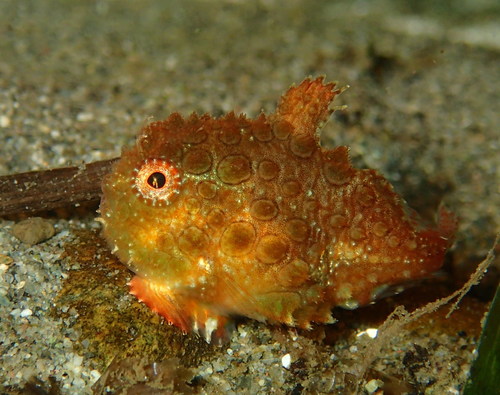
As a member of the Cottidae family, the longhorn sculpin possesses the same general body plan. This entails an elongated body with very large, fanned pectoral fins that allow it to lay flat against the benthic floor. They have disproportionately large heads and exaggerated fins with large spines present. Their caudal fin is rounded, as sculpins do not require very fast propulsion. They possess two dorsal fins and their pelvic fins are located anteriorly.

Coloration-wise, the longhorn sculpin is extremely variable, depending on its surroundings. It relies on cryptic camouflage to prevent detection and therefore matches the surrounding corals or rocks closely. Despite the scientific name roughly translating to "18-spined", the longhorn sculpin possesses 20 spines on its head. Additionally, it possess 15 or 16 dorsal rays and 14 anal spines.
Habitat

The longhorn sculpin is a demersal, or bottom-dwelling, species that lives in the temperate waters of the northwest Atlantic Ocean. Its range extends as far north as the waters offshore of eastern Newfoundland and the northern Gulf of Saint Lawrence in Canada (52°N). It is found as south as the waters near Virginia in the USA (36°N). It has been found as far inland as 77°W and as far offshore as 50°W. It lives in shallow coastal waters, sometimes utilizing intertidal zones, but moves to deeper waters in the winter. The longhorn sculpin is found in waters from 50m to 100m in depth and waters from 0.5 °C to 19 °C.

Behaviour

As adults, longhorn sculpins serve as a benthic, mesopredator foragers. This means that they lie near the middle of the food web, with a large variety of prey but also possessing many predators. The longhorn sculpin commonly consumes crustaceans and smaller fishes near the bottom of the water column. Longhorn sculpins also indulge in opportunistic scavenging and will feed on discarded remains of molluscs when able. This has resulted in them gathering underneath scalloping boats, where shucked remains fall to the sea floor.

Part of

Where to see it

No dive sites list Longhorn Sculpin yet. Explore the map to find sites near you.