
← All marine life
Long-Snouted Seahorse
Species IUCN · Near Threatened (NT)

Long-Snouted Seahorse

Hippocampus guttulatus, Cuvier, 1829

marinebrackish

About Long-Snouted Seahorse

Hippocampus guttulatus, commonly known as the long-snouted seahorse and in Great Britain as the spiny seahorse, is a marine fish belonging to the family Syngnathidae. It is native to the northeast Atlantic, including the Mediterranean.

Appearance

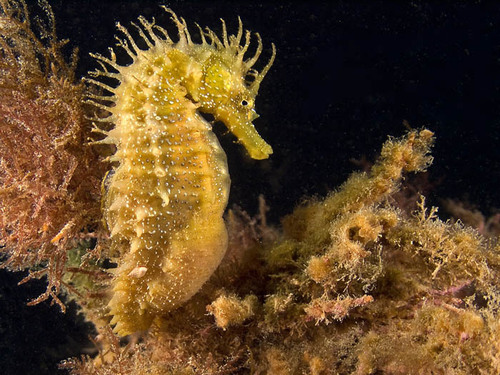
The long-snouted seahorse is a small-sized fish that can reach a maximum length of 21.5 cm (8+1⁄2 in), but the average size is approximately 12 cm (5 in).

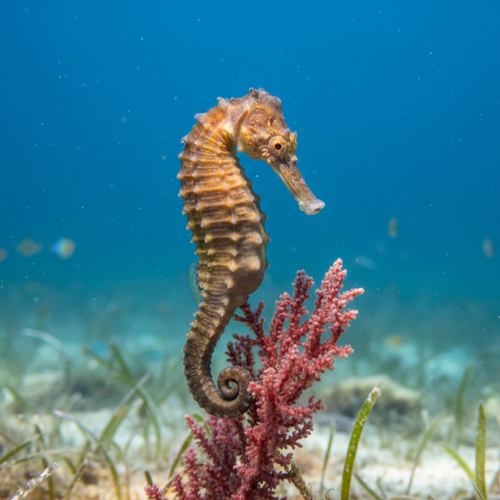
The body is slender, the snout is long and the tail is prehensile.

Its head and dorsal ridge often have many long dermal filaments which can be simple or bifid.

Its color ranges from dark green to different variants of brown to yellow, and the body is often speckled with small white dots.
Habitat

The long-snouted seahorse is widespread throughout the temperate waters of the eastern Atlantic Ocean from the south coast of the United Kingdom to the Netherlands and south to Morocco, including the Canary Islands, the Azores and Madeira, Italy and the Mediterranean Sea.

The longsnout seahorse ranges from black to yellow, red, orange and brown with multiple white dots usually on the tail.

This seahorse likes shallow coastal waters from 1 to 20 m (3 to 66 ft) deep. It occurs close by Posidonia and seagrass meadows or in mixed habitat with sandy bottom and rocks with algae.

Humans & conservation

The long-snouted seahorse is relatively rare, and limited data exists on its population and about the volume and the impact of trade for traditional Chinese medicine and for the aquarium. The species is therefore considered as "Data Deficient" on the IUCN Red List.

Internationally, it is also listed in Appendix II of the Convention on International Trade in Endangered Species of Wild Fauna and Flora (CITES). This means that it is on the list of species not necessarily threatened with extinction, but for which trade must be controlled in order to avoid utilization incompatible with their survival.

Part of

Where to see it

No dive sites list Long-Snouted Seahorse yet. Explore the map to find sites near you.