← All marine life
Little Tunny
Species IUCN · Least Concern (LC)

Little Tunny

Euthynnus alletteratus, (Rafinesque, 1810)

marinebrackish

About Little Tunny

The little tunny (Euthynnus alletteratus), also known as the little tuna, false albacore, or erroneously as the blue bonito, is a species of tuna in the family Scombridae. It can be found in the Atlantic Ocean and the Mediterranean and Black seas; in the western Atlantic, it ranges from Brazil to the New England states. The little tunny is a pelagic fish that can be found regularly in both offshore and inshore waters, and it is classified as a highly migratory species. The little tunny is best identified by the "worm-like" markings on its back and the dark spots appearing between its pectoral and ventral fins.

Commercially, the fish is used as bait for sharks and marlin due to its high oil content and hook retention. Because of its strong "fishy" taste and the considerable effort required to prepare it, the little tunny is considered by many to be a rough fish and is not commonly eaten. However, it is sought after as a sport fish due to its line-stripping 64 km/h (40 mph) runs and hard fighting ability when hooked. By trolling with lures near reefs, it can be caught on hook and line.

Appearance

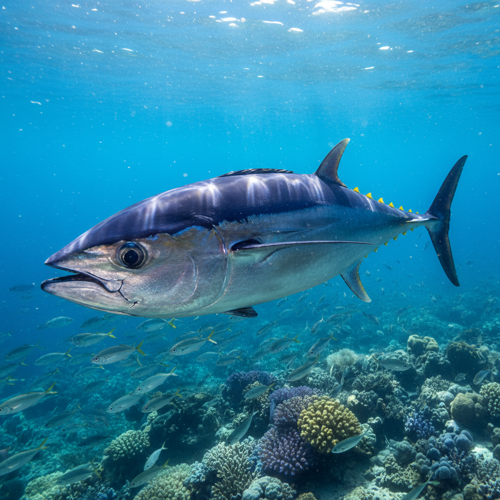
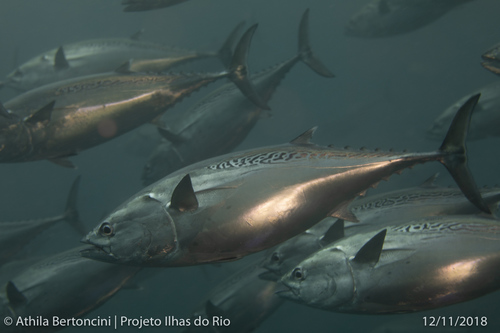
The little tunny is small in body size compared to other tuna species. It has a compact and stream-lined body built to facilitate bursts of speed, as well as endurance while swimming. Its torpedo-shaped, robust body is made for powerful swimming. It has a large mouth with rigid jaws and a slightly protruding lower jaw, with a single row of small, inwardly curved, cone-shaped teeth on the palate. Teeth are absent on the vomer, the small bone in the roof of the mouth, and the tongue has two longitudinal ridges.

Habitat

The little tunny is found in the neritic waters of the temperate and tropical zones in the Atlantic Ocean. It can also be found in the waters of the Mediterranean Sea and the Black Sea. In the eastern Atlantic, the little tunny has been found from Skagerrak to South Africa. Although found it this broad range of latitudes, it is rare north of the Iberian Peninsula or farther south than Brazil. On the Atlantic coast of the United States, they can be caught as far north as Cape Cod, Massachusetts, and as far south as the tip of Florida, as well as throughout the waters of the Gulf of Mexico.

Diet

In coastal waters along the North American eastern seaboard, little tunny are carnivorous, and primarily feed on small fish and invertebrates that occur in schools. Its diet consists mostly of fish; it particularly likes the Atlantic bigeye and largehead hairtail. Second to fish, the little tunny consumes crustaceans, and lastly cephalopods and gastropods make up a small part of its diet. Sardines, scad, and anchovies are common in the diet along with squid, stomatopods, and organisms from the family Diogenidae. The diet of the fish is also relative to its size. A smaller fish's diet typically consists of clupeiforms, and larvae, while the larger fish mostly eat Maurolicus muelleri. The typical diet is very similar to that of the king mackerel because the fish are of a similar size and live in the same area of the water column.

Reproduction

Little tunny spawn in water that is at least 25 °C (77 °F) in the months of April through November in the Atlantic Ocean. The spawning season of the little tunny in the Mediterranean is generally between May and September, but the most intensive spawning occurs between July and August. The major spawning areas are offshore, in waters that are 30 to 40 metres deep. The females are prolific fish, and can release 1.75 million eggs, in multiple clutches over a mating season. The eggs are fertilized in the water column after the males release sperm. The eggs are buoyant, spherical, transparent, and pelagic. A droplet of oil within the egg adds to its buoyancy. The diameter of the eggs can be anywhere from 0.8 mm to 1.1 mm, and they are light amber. Larvae are released 24 hours after fertilization and are approximately 3 mm in size. Pigmentation in the eyes appear 48 hours after hatching.

Part of

Where to see it

No dive sites list Little Tunny yet. Explore the map to find sites near you.