
← All marine life
Lingcod
Species

Lingcod

Ophiodon elongatus, Girard, 1854

marine

About Lingcod

The lingcod or ling cod (Ophiodon elongatus) is a fish of the greenling family Hexagrammidae. Despite its name, the lingcod is neither a cod nor a ling. It is also known as the buffalo cod, cultus cod, or Buckethead. It is the only extant member of the genus Ophiodon. A slightly larger, extinct species, Ophiodon ozymandias, is known from fossils from the Late Miocene of Southern California.

Ophiodon elongatus is native to the North American west coast from Shumagin Islands in the Gulf of Alaska to Baja California, Mexico. It has been observed up to a size of 152 centimetres (60 in) and a confirmed weight of 39 kilograms (86 lb), with unconfirmed reports of fish weighing more than 50 kilograms (110 lb).

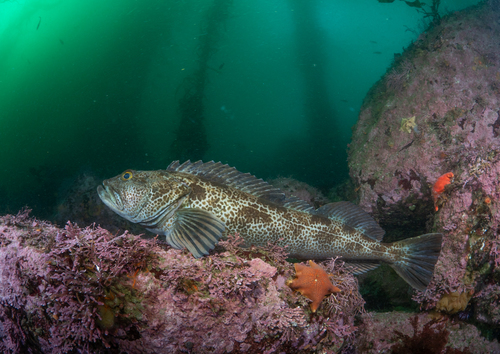
It is spotted in various shades of gray. The lingcod is a popular eating fish and is thus prized by anglers. Though not closely related to either ling or cod, the name "lingcod" originated because it somewhat resembles those fish. Around 20% of lingcods have blue-green to turquoise flesh.p. 298 The color, which is no longer present after cooking, may be due to biliverdin, but this has not been established beyond doubt.

Appearance

Lingcod have several variations in their appearance, including dark gray, blue, brown, or green coloring on the back, sometimes accompanying mottling or spotting on the upper back that is copper colored. The belly is typically lighter than the body. Lingcod typically has a large head and mouth where the upper jaw extends posteriorly past the eyes. They have 18 large and sharp teeth that are canine-like. This body of a lingcod resembles a fusiform body plan, indicating their primary mode of movement is quick, short, bursts. The head of a lingcod is unscaled and has a cirrus above the eye. Lingcod's lateral line is prominent and white while the body is covered in cycloid scales. The dorsal fin is composed of spines and rays, separated by a notch. The anal fin also contains 3 spines. Lingcod do not have a swim bladder.

Habitat

Ophiodon elongatus is native to the North American west coast from the Shumagin Islands in the Gulf of Alaska to Baja California, Mexico. They are found on the bottom, with most individuals occupying rocky areas at depths of 10–100 metres (33–328 ft), however, lingcod has been found at depths of 475 m (1,558 ft). Tagging studies have shown lingcod is a largely nonmigratory species, with colonization and recruitment occurring in localized areas only. However, lingcod are the most abundant near British Columbia, Canada, and Washington, USA. The lingcod within this range are composed of two stocks, whose status is maintained by NOAA Fisheries: The Northern Pacific stock and the Southern Pacific stock.

Diet

Adult lingcod are aggressive predators. They consume other bottom-dwelling fish, including other lingcod, rockfishes, squid, octopus, and crab. They are "known to prey on almost anything they can get in their mouths."

Larval lingcod feed on zooplankton, krill, and larval crustaceans, while juvenile lingcod feed on small fish.

Lingcod are most vulnerable to predators as eggs and larvae. Adult males therefore guard the egg nests (see next section). But this, as well as their shoreward migration during spawning, makes them vulnerable to predation by seals, sea lions, and anglers.

Reproduction

Lingcod can live for more than 20 years, but typically only live up to 14 years for males and 20 years for females.

Starting in November, male lingcod migrate to nearshore spawning grounds and establish territories. Such interannual nest fidelity coupled with great precision of the site is one of the first recorded examples of such behaviors in temperate marine fish. This behavior also provides evidence that male lingcod's selection for nesting sites are a component of prespawning mate attraction behavior.

Humans & conservation

According to the NOAA Fisheries, both population stocks (The Northern Pacific Coast and Southern Pacific Coast stocks) of lingcod are not overfished as of the 2021 stock assessment and are not subjected to overfishing based on 2021 catch data. More information and updated information may be found at Stock SMART (noaa.gov) for the Northern Pacific stock and Stock SMART (noaa.gov) for the Southern Pacific stock.

Where to see it

No dive sites list Lingcod yet. Explore the map to find sites near you.