
← All marine life
Limbaugh's Chromis
Species IUCN · Least Concern (LC)

Limbaugh's Chromis

Chromis limbaughi, Greenfield & Woods, 1980

marine

About Limbaugh's Chromis

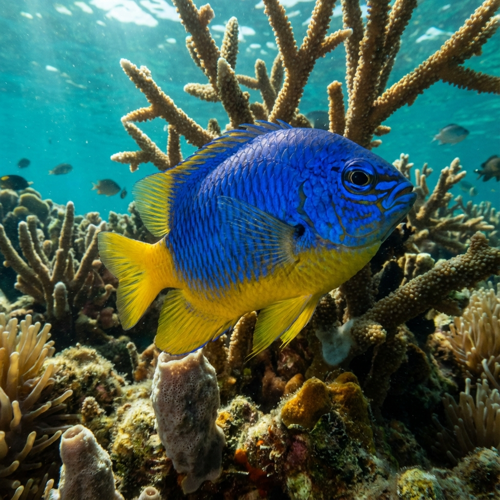
Chromis limbaughi is a small species of ray-finned fish, often called the blue and yellow damselfish or Limbaugh's damselfish. It belongs to the family Pomacentridae, encompassing the clownfish and damselfish, and is a member of the Chromis genus. It is bright blue near the head and gradually fades to a bright yellow near the dorsal and caudal regions. C. limbaughi aggregate during the day, forming relatively small schools swimming close to the bottom of the reef, feeding on zooplankton. The blue and yellow damselfish was first identified by photographer Conrad Limbaugh, who captured two specimens in 1953 and took the first photographs of this species.

Appearance

Limbaugh's damselfish is deep-bodied, being deeper from its dorsal to its ventral region than it is wide. These fish typically exhibit 13 dorsal spines followed by 11-12 dorsal fin rays, 18-19 pectoral fin rays, and dorsal lateral fin lines with 15-18 tubed scales. Distinctive dark spots are present on the upper portion of the pectoral fin base. C. limbaughi can be distinguished from other members of its genus, C. atrilobata and C. intercrusma, by the presence of 13 dorsal fin spines; from C. punctipinnis by its deeper body; from C. crusma by its fewer tubed lateral line scales; from C. meridiana by three exposed spiniform procurrent caudal fin rays and 13 dorsal fin rays, and from C. alta by soft anal fin rays and by a distinct dark spot in the upper portion of the pectoral fin base that is absent in C. alta.
Habitat

Blue and yellow damselfish are small fish found among rocky and coral reef systems around the Gulf of California and as far south as Banderas Bay, Mexico.

Behaviour

Blue and yellow damselfish are gonochoristic species; they're either male or female throughout their life and lack sexual dimorphism. Additionally, they also display promiscuous behavior, a common trait among gonochoristic species. While most other Chromis species engage in haremic behavior with a greater female to male ratio in the wild, C. limbaughi sex ratios were closer to 1:1 and did not form harems; Rather, this species engages in polygamy, mating with multiple males and females. Other damselfish males exhibit highly territorial and aggressive behavior; however, blue and yellow damselfish are atypically mild-mannered, making them an attractive choice for aquarists. C. limbaughi experiences reproductive peaks during spring and summer, May through September. Male size at sexual maturity is 7.90 cm, and females reach 7.59 cm.

Humans & conservation

The species is considered 'Least Concern' by the I.U.C.N. Red List because it is not used for consumption, is relatively available, and has no reported reduced population. Despite this, the Mexican government has classified the species as 'special protection, since the species is one of the three most important fish in the aquarium trade since the 1970s. Fishing permits are routinely offered for C. limbaughi and other species for small fishing cooperatives in the Gulf of California. Unfortunately, hard data on fish catches are unknown because keeping and reporting among fisheries are nonexistent or not enforced, suggesting a possible increase in overexploitation and or illegal fishing of the species. However, recorded captures include C. limbaughi as one of the five most captured fish in Mexican waters.

Part of

Where to see it

No dive sites list Limbaugh's Chromis yet. Explore the map to find sites near you.