
← All marine life
Lemon Shark
Species IUCN · Vulnerable (VU)

Lemon Shark

Negaprion brevirostris, (Poey, 1868)

marinebrackish

About Lemon Shark

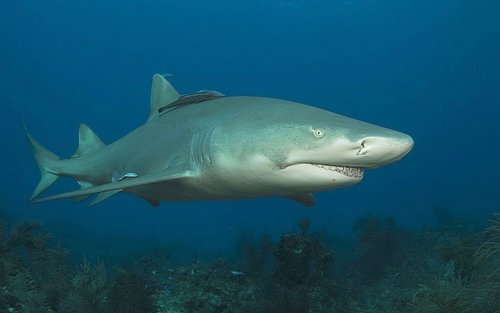
The lemon shark (Negaprion brevirostris) is a species of requiem shark from the family Carcharhinidae, known for its yellowish skin, which inspires its common name.

The lemon shark is classified as a "vulnerable" species by the International Union for the Conservation of Nature.

Lemon sharks can grow to 3.4 m (11 ft) in length. They are often found in shallow subtropical waters and are known to inhabit and return to specific nursery sites for breeding. Often feeding at night, these sharks use electroreceptors to find their main source of prey, fish. Lemon sharks enjoy the many benefits of group living, such as enhanced communication, courtship, predatory behavior, and protection. This species gives birth to live young, and the females are polyandrous and have a biennial reproductive cycle. Lemon sharks are not thought to be a large threat to humans; only 10 bites have been recorded, none of which were life-threatening. The lemon shark's lifespan is unknown, but the typical shark is 25 to 30 years old.

In 2023, the oldest recorded lemon shark in captivity died at the age of 40 years.

Appearance

The lemon shark's yellow coloring serves as an excellent camouflage when swimming over the sandy seafloor in its coastal habitat.

The lemon shark commonly attains a length of 2.4 to 3.1 m (7.9 to 10.2 ft) and a weight up to 90 kg (200 lb) by adulthood, although sexual maturity is attained at 2.24 m (7.3 ft) in males and 2.40 m (7.9 ft) in females. The maximum recorded length and weight is 3.43 m (11.3 ft) and 183.7 kg (405 lb), respectively.

The lemon shark has a flattened head with a short, broad snout, and the second dorsal fin is almost as large as the first. Like all cartilaginous fishes, lemon sharks have electroreceptors concentrated in their heads, known as the ampullae of Lorenzini. These receptors detect electrical pulses emitted by potential prey and allow these nocturnal feeders to sense their prey in the dark.
Habitat

Lemon sharks are found from New Jersey to southern Brazil in the tropical western Atlantic Ocean. They also live off the coast of west Africa in the southeastern Atlantic. In addition, lemon sharks have been found in the eastern Pacific, from southern Baja California to Ecuador and in Cape Verde in Sal Island.

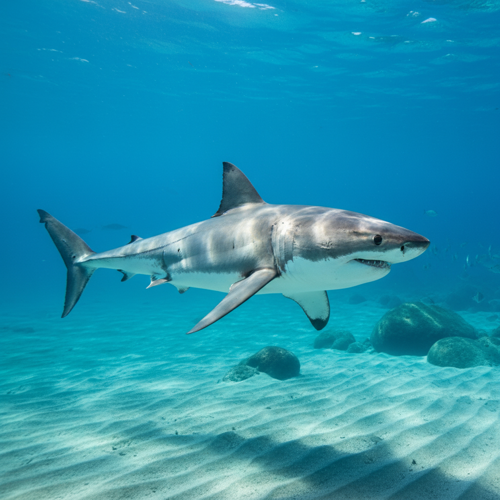
Although the lemon shark species is known for occupying the subtropical, shallow waters of coral reefs, mangroves, enclosed bays, and river mouths, they have also been found in the open ocean down to depths of 92 m (302 ft).

Lemon sharks have been observed swimming up rivers, but they do not appear to travel very far into fresh water. They are found in open water primarily during migrations, tending to stay along the continental and insular shelves for most of their lives.

Behaviour

Many species of sharks, including the lemon shark, are known to be social, living in groups or loose aggregations.

A few benefits of group living are enhanced communication, courtship, predatory behavior, and protection. Group living and a preference for social interaction is thought to be important for the survival and success of juvenile lemon sharks. Up to twenty juveniles have been observed in groups of lemon sharks. Group living, however, comes with its costs, such as increased risk of disease, ease of parasite transmission, and competition for resources.

Reproduction

Lemon sharks congregate for reproduction at special mating grounds. Females give birth to their young in shallow nursery waters to which they are philopatric. Lemon shark young are known as pups and they tend to remain in the nursery area for several years before venturing into deeper waters. Lemon sharks are viviparous, meaning that the mother directly transfers nutrients to her young via a yolk-sac placenta and the young are born alive. Fertilization is internal and occurs after a male lemon shark holds a female, bites her, and inserts his clasper into her cloaca.

Humans & conservation

This species of shark is among the best known in its behavior and ecology, mainly due to the work of Samuel Gruber at the University of Miami, who studied the lemon shark both in the field and in the laboratory from 1967. The population around the Bimini Islands in the western Bahamas, where Gruber's Bimini Biological Field Station is situated, is probably the best known of all shark populations.

Part of

Where to see it

No dive sites list Lemon Shark yet. Explore the map to find sites near you.