
← All marine life
Laver Spire-Shell
Species

Laver Spire-Shell

Peringia ulvae, (Pennant, 1777)

marinebrackish

About Laver Spire-Shell

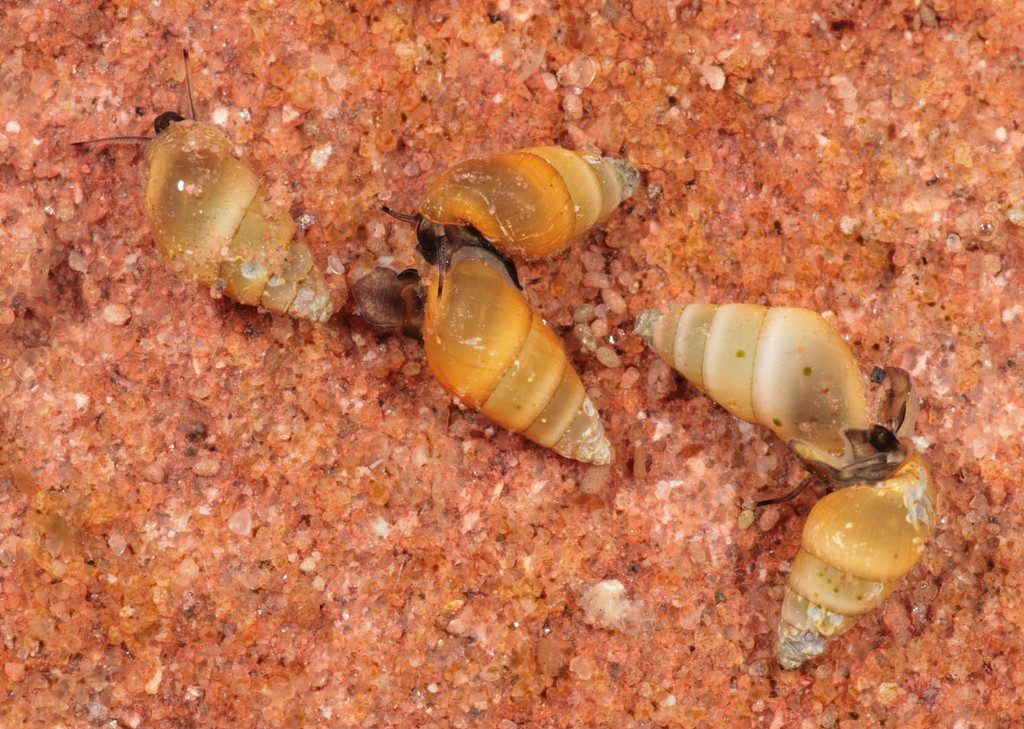
Peringia ulvae, commonly known as the Laver spire shell or mudsnail, is a European species of very small aquatic snail with gills and an operculum, a gastropod mollusk in the family Hydrobiidae.

This is arguably a marine snail, but it is often also listed as a non-marine species because it tolerates brackish water and lives in salt marshes and similar habitats.

Peringia ulvae is the type species of the genus Peringia.

Appearance

This species was originally described by Welsh naturalist Thomas Pennant in 1777. Pennant's original text (the type description) reads as follows:

T. with four spires, the first ventricose; of a deep brown color; aperture oval.

Inhabits Ulva Lactuca on the shores of Flintshire.

"T." is an abbreviated word testa from Latin language, that means "shell".

The shell is often heavily corroded, usually whitish with brown peristome present on the last whorl. The shell has 5-7 very weakly convex whorls, that are regularly increasing but not always regularly rounded. The lip is attached to the last whorl.

The width of the shell is 2.5–3 mm. The height of the shell is 4-5.5 mm.

Habitat

This species occurs on the coasts of the Baltic Sea, the White Sea the eastern Atlantic Ocean and the western Mediterranean Sea, (the Mediterranean records may be in error) including:

The type locality is "on the shores of Flintshire", Wales, United Kingdom. The distribution type is Oceanic Wide Temperate

Where to see it

No dive sites list Laver Spire-Shell yet. Explore the map to find sites near you.