
← All marine life
Lane Snapper
Species IUCN · Near Threatened (NT)

Lane Snapper

Lutjanus synagris, (Linnaeus, 1758)

marine

About Lane Snapper

The lane snapper (Lutjanus synagris), Mexican snapper, redtail snapper or spot snapper is a species of marine ray-finned fish, a snapper belonging to the family Lutjanidae. It is native to the western Atlantic Ocean.

Appearance

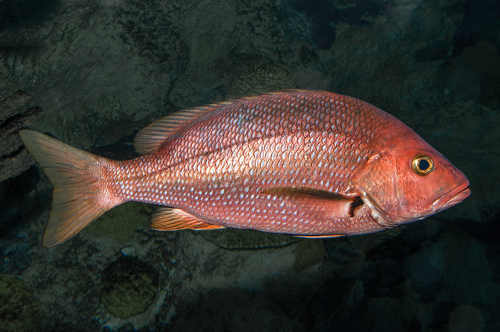
The lane snapper has an oblong, compressed body. It has a sharply pointed snout, With a pair of front and a pair of rear nostrils which are simple holes, it has a relatively large mouth with a moderately protrusible upper jaw which has most of its length below the cheek bone when the mouth is shut., Each jaw has one or more rows of sharp, conical teeth with a few of these being enlarged to form canines. The vomerine teeth are arranged in an anchor shaped patch of teeth with a short rearwards extension along the middle of the palate and there is a pair of tooth patches ar either side of the palate. The preopercle is serrated, and has a weakly developed incision and knob. It has a continuous dorsal fin which has 10 spines and 12-13 soft rays, with a slight incision sometimes visible between the spines and soft rays, the anal fin has 3 spines and 8-9 soft rays.
Habitat

The lane snapper is found in the Western Atlantic Ocean where it occurs as far north as North Carolina and Bermuda south through the Gulf of Mexico and the Caribbean Sea, along the coast of South America as far south as Santa Catarina, Brazil. It occurs over reefs and sandy bottoms with algae or sea grass at depths between 30 and 122 m (98 and 400 ft). The juveniles live in sheltered inshore waters.

Diet

Lane snappers are opportunistic, nocturnal predators feeding on a diverse range of animals. Known prey includes smaller fishes, cephalopods, gastropods, and crustaceans such as shrimps and crabs.

Reproduction

Lane snapper form spawning aggregations, off Cuba these aggregations are found from March until September, peaking in activity in July and August. Off Puerto Rico spawning reaches its zenith in May. They are broadcast spawners, the fertilised eggs drift on the currents and hatch after 23 hours. The larvae are little known but settle at a length of about 1 cm (0.39 in).

Humans & conservation

The white meat of the lane snapper is sold in supermarkets throughout Mexico. Lane snapper are more typically caught in shallower waters than many other snappers, most commonly yellowtail snapper and gray snapper. Larger specimens can be found in somewhat deeper waters, but are typically less plentiful. The consumption of its flesh has been known to result in cases of ciguatera poisoning.

Lane snapper are caught with beach seines, boat seines, traps, handlines, and bottom trawls. Shrimp fisheries take for a large portion of the total catch of this snapper, due to the juveniles preference for soft bottom s with high populations of shrimps.

The lane snapper stocks have shown steep declines as a result of overfishing in much of its range. For this reason the IUCN have assessed this species as Near Threatened.

Part of

Where to see it

No dive sites list Lane Snapper yet. Explore the map to find sites near you.