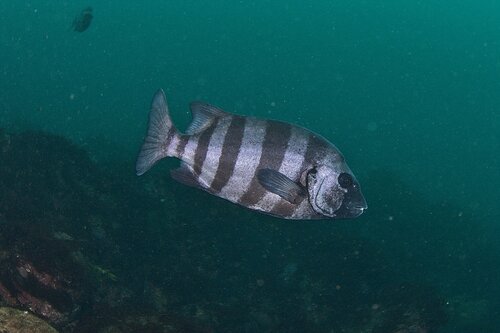
The barred knifejaw (Oplegnathus fasciatus), also known as the striped beakfish or rock bream, is a species of marine ray-finned fish, from the family Oplegnathidae. It is commonly native to the north-western Pacific Ocean, though a smattering of records exist from other localities in the eastern Pacific such as Hawaii and Chile. Recently introduced – likely via ballast water – in the central Mediterranean, it is found very rarely from Malta to the northern Adriatic. There is no listed conservation status for this species, though it is farmed for consumption and angling in many Asian countries suggesting it is common.
The barred knifejaw is an inhabitant of rocky reefs and occurs at depths from 1 to 10 m (3 to 33 ft). Juvenile members of this species can be found with patches of drifting seaweed. This species can reach a total length of 80 cm (31 in), with the greatest recorded weight for this species of 6.4 kg (14 lb). As with all members of the Oplegnathus family, the barred knifejaw has a beak-like structure formed by the fusion of its teeth. One of the biggest identifying characteristics of O. fasciatus is the 7 vertical black bars along both sides of its body, from which it derives its name. The first bar characteristically begins over the eye of the fish and the last is on the body’s narrowing towards the caudal peduncle. The end of the caudal fin is also typically black-tipped.