
← All marine life
Kelp Bass
Species IUCN · Least Concern (LC)

Kelp Bass

Paralabrax clathratus, (Girard, 1854)

marine

About Kelp Bass

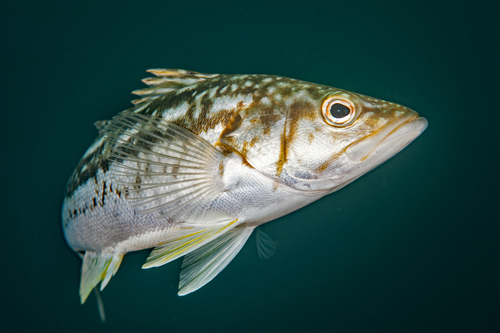
Paralabrax clathratus, the kelp bass, bull bass or calico bass, is a species of marine ray-finned fish, from the subfamily Serraninae, classified as part of the family Serranidae which includes the groupers and anthias. It is found in the eastern North Pacific Ocean where it is an important species for both recreational and commercial fisheries.

Appearance

Paralabrax clathratus has an elongate, relatively deep, compressed body with a pointed snout and a large, downturned mouth. The mouth extends back as far as the centre line of the pupil and the lower mandible protrudes to form part of the snout. There are teeth all over the roof of the mouth. The margins of the preopercle have fine serrations. There is a large spine on the edge of the gill cover. The dorsal fin has 10 spines and 13–14 soft rays, the 3rd and 4th spine are the longest, both being nearly twice the height of the 2nd spine. The anal fin has 3 spines and 7 soft rays. The caudal fin is truncated, although the margin can be wavy.
Habitat

Paralabrax clathratus is found in the eastern North Pacific Ocean off the western coast of North America. Its range extends from the central California south to the southern tip of Baja California. It was formerly found as far north as the mouth of the Columbia River on the boundary between Oregon and Washington State but it is now rare anywhere north of Point Conception in California.

Humans & conservation

Paralabrax clathratus is ranked as the second most abundant California shallow water generalist and it is not officially considered to be endangered in any part of its habitat. However, its survival is threatened by fluctuations in ocean surface temperatures and overfishing. Currently, marine protected areas (MPAs) are the only places in which fishing for kelp bass is illegal. As of 2024, only 16.1 percent of California's territorial waters are designated as MPAs. From 1974 to 2014, a 97 percent reduction in the abundance of kelp bass was observed in southern California using entrapment monitoring data. Ocean warming and acidification can wreak havoc on kelp forest ecosystems. The excessive heat and lack of nutrients can cause kelp fronds to wilt on mass. Primary consumers that feed on kelp will die out after losing their main food source.

Part of

Where to see it

No dive sites list Kelp Bass yet. Explore the map to find sites near you.