
← All marine life
Japanese Pygmy Seahorse
Species IUCN · Least Concern (LC)

Japanese Pygmy Seahorse

Hippocampus japapigu, Short, Smith, Motomura, Harasti & Hamilton, 2018

marine

About Japanese Pygmy Seahorse

The Japanese pygmy seahorse (Hippocampus japapigu) is a Japanese species of seahorse in the family Syngnathidae. It is also sometimes known as the Japan pig.

Appearance

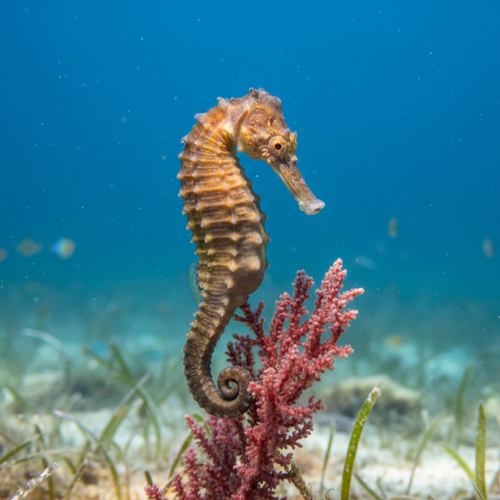
It reaches a length of 1.6 cm, and contains 28 tail rings, 14 dorsal fin rays, 9 pectoral fin rays, and 4 subdorsal rings. It is the size of a jellybean, and its coloration is made for hiding in algae-covered reefs, clinging to soft corals while feeding on plankton. It has a pair of wing-like protrusions on its neck; unlike other species, it contains only one pair instead of two, and is the only seahorse in the world known to have a bony ridge running down its back.
Habitat

It lives in Northwestern Pacific near Japan, and lives at depths from 5 to 22 meters, but its usually found at 10 to 13 meters, but does not live with any specific species to host, and instead clings onto algal turfs in subtropical reefs.

As of 2018, H. japapigu is only known to be found in Japan, including Kashiwa-jima Island, Sukumo Bay; Kushimoto, Kii Peninsula; Osezaki, Izu Peninsula; the Izu Islands of Miyake and Hachijo; Sagami Bay; and Chichi-jima, Ogasawara Islands.

The type locality was collected off Imasaki, Okago, Hachijo-jima Island, Izu Islands at a depth of 10 m (33 ft).

Reproduction

The broad pouch of the pygmy seahorse is present within the body cavity and located on the trunk, in contrast to tail-brooding non-pygmy seahorses.

Part of

Where to see it

No dive sites list Japanese Pygmy Seahorse yet. Explore the map to find sites near you.