
← All marine life
Indian Scad
Species IUCN · Least Concern (LC)

Indian Scad

Decapterus russelli, (Rüppell, 1830)

marine

About Indian Scad

Decapterus russelli, also known as the Indian scad, northern mackerel scad, round scad, Russell's mackerel scad, slender scad, or three lined grunter, is a species of ray-finned fish in the family Carangidae. It naturally occurs in the Indian and the western Pacific Oceans and has colonised the eastern Mediterranean through the Suez Canal. It is an important species in coastal fisheries throughout its range.

Appearance

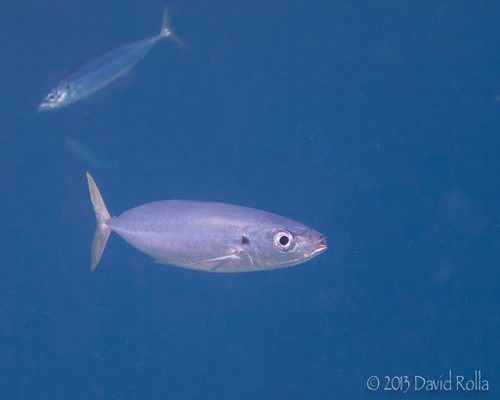
Decapterus russelli has an elongate, somewhat slender and slightly compressed body. The eyes are of moderate size and have a well developed adipose eyelid which completely covers eye apart from a vertical slit which has the pupil in its centre. The scales on top of head do not reach a line running through the centre of pupil. The lateral line has a low regular arch towards the head and the curved and straight parts meet below the second dorsal fin between 11th to 13th soft rays; there are 42–62 scales in the curved part of the lateral line and between 0 and 4 scutes, while the straight part has 0 to 4 scales which are followed by 30 to 40 scutes, meaning that the total count of scales and scutes is between 77 and 102 if caudal scutes are excluded).
Habitat

Decapterus russelli occurs throughout the Indian Ocean, from the coasts of eastern Africa from the Gulf of Suez as far south as South Africa to Indonesia, eastwards into the western Pacific Ocean, from Japan in the north and south to Australia. First recorded in the Mediterranean Sea off Israel in 2005, it is now common in Levantine waters up to Iskenderun (Turkey) and has become an important species in local fisheries.

Humans & conservation

Decapterus russelli is fished for wherever it occurs, normally using seine nets and trawls. In 1999 the total catch was just short of 160,000 tonnes, with the two major fishing nations being Thailand and Malaysia, which landed 82,000 tonnes and 70,160 tonnes respectively. Since the 1950s the weight of Indian scad landed fluctuates and there is no increasing or decreasing trend apparent in the population, however in south-east Asia there has been a marked increase in effort which has not seen an increase in landings suggesting the fishery is over-exploited. It is generally marketed fresh, may be dried or salted, as well as being sold frozen and canned.

Part of

Where to see it

No dive sites list Indian Scad yet. Explore the map to find sites near you.