
← All marine life
Indian Sailfin Tang
Species IUCN · Least Concern (LC)

Indian Sailfin Tang

Zebrasoma desjardinii, (Bennett, 1836)

marine

About Indian Sailfin Tang

Zebrasoma desjardinii, commonly known as the Red Sea sailfin tang, Desjardin's sailfin tang or the Indian sailfin tang, is a species of marine ray-finned fish in the family Acanthuridae (the surgeonfishes, unicornfishes and tangs). It is found in the Indian Ocean.

Appearance

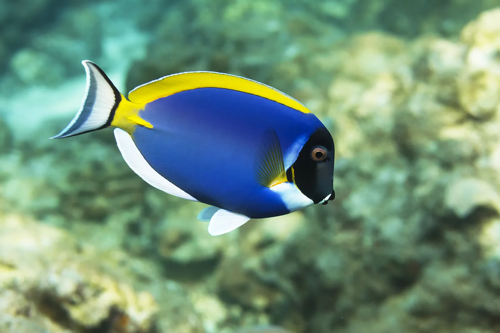
Zebrasoma desjardinii has a tall dorsal fin that has 4 spines and between 27-31 soft rays (the longest of which is around half of the standard length); these figures for the anal fin are 2 and 22-24 respectively. It has a deep body, with the standard length being 1.8 to 2 times its depth; the maximum published total length is 40 cm (16 in). The mouth protrudes with a concave profile on the snout. The spine in the caudal peduncle has a narrow posterior connection to the body, and the caudal fin is truncate. The body is grey, with around 8 dark grey vertical bars; each bar houses 2 or 3 orange or yellow vertical lines, which break up into spots towards the lower body and on the anal fin. There are 2 dark brown bars on the head, with the first one passing through the eye.
Habitat

Zebrasoma desjardinii is found in the Indian Ocean, including the eastern coast of Africa (as south as Sodwana Bay, South Africa) and the Middle East (e.g. the coasts of Israel, Saudi Arabia and Yemen). It is also found across the islands of the Indian Ocean (such as Sri Lanka, islands in the Andaman Sea, Sumatra, Java, the Cocos Islands and Christmas Island). In 1999, a pair of this species was recorded in the Atlantic Ocean, off Florida, but this was probably due to aquarium release.

Zebrasoma desjardinii is found at depths between 1–30 m (3.3–98.4 ft) in lagoon and seaward reefs, although the juveniles are more typically found in sheltered areas within reefs.

Behaviour

Zebrasoma desjardinii adults usually can be found in pairs, while juveniles are solitary. They feed primarily on filamentous algae, macroalgae and plankton, but individuals in the Red Sea have been regularly observed feeding on moon jellies (Scyphozoa) and comb jellies (Ctenophora) as well. This species may form aggregations while feeding on algae; if they do so within the territory of the predatory slingjaw wrasse, the wrasse may darken itself so as to match the color of the tangs. The wrasse then joins in the aggregation and mimics their algae-feeding actions while hunting prey.

Zebrasoma desjardinii is a pair spawner; while this is the typical trait of the species in its genus, group spawning is more common at the family level.

Part of

Where to see it

No dive sites list Indian Sailfin Tang yet. Explore the map to find sites near you.