Appearance
Most hydrozoan species include both a polypoid and a medusoid stage in their life cycles, although a number of them have only one or the other. For example, Hydra has no medusoid stage, while Liriope lacks the polypoid stage.

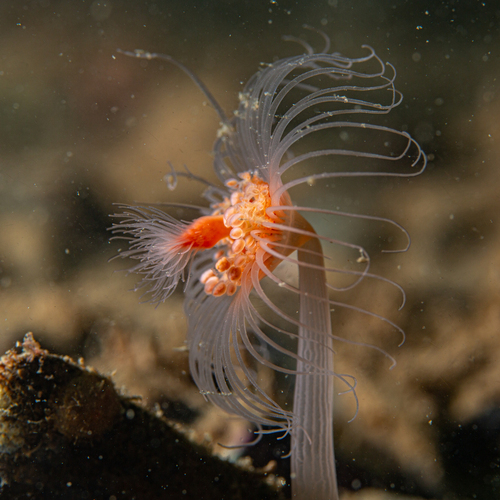
Hydrozoa, Owen, 1843
Hydrozoa (hydrozoans; from Ancient Greek ὕδωρ (húdōr) 'water' and ζώα (zóa) 'animals'), also called hydroids, are a taxonomic class of individually very small, predatory cnidarian animals, some solitary and some colonial, most of which inhabit saline water. The colonies of the colonial species can be large, and in some cases the specialized individual animals cannot survive outside the colony. A few genera within this class live in freshwater habitats. Hydrozoans, together with the true jellyfish, or scyphozoans, are members of the cnidarian subphylum Medusozoa.
Some examples of hydrozoans are the freshwater jelly (Craspedacusta sowerbii), freshwater polyps (Hydra), Obelia, Portuguese man o' war (Physalia physalis), chondrophores (Porpitidae), and pink-hearted hydroids (Tubularia).
Most hydrozoan species include both a polypoid and a medusoid stage in their life cycles, although a number of them have only one or the other. For example, Hydra has no medusoid stage, while Liriope lacks the polypoid stage.
Hydroid colonies are usually dioecious, with the polyps in each colony being either all male or all female. In some species, the reproductive polyps, known as gonozooids (or "gonotheca" in thecate hydrozoans) bud off asexually produced medusae. These tiny, new medusae (which are either male or female) mature and spawn, releasing gametes freely into the sea in most cases. Zygotes become free-swimming planula larvae or actinula larvae that either settle on a suitable substrate (in the case of planulae), or swim and develop into another medusa or polyp directly (actinulae). Colonial hydrozoans include siphonophore colonies, Hydractinia, Obelia, and many others.
No dive sites list Hydroid yet. Explore the map to find sites near you.